Sunday, July 28, 2013
Supreme Court shoots down motion on pink sheets
July 10, 2013 (Page 16)
THE Supreme Court on July 9, 2013 refused to grant a request from the petitioners in the presidential election challenge which prayed it to refer issues on 1,545 pink sheets to the international audit firm, KPMG, for further consideration.
The court, however, gave the petitioners the nod to cross-examine the Chairman of the Electoral Commission (EC), Dr Kwadwo Afari-Gyan, on the said pink sheets.
Following the exclusion of the 1,545 pink sheets in the final analysis of the KPMG report, the petitioners had prayed the court to grant their request in order to establish a comprehensive unique count of pink sheets they had filed, but the respondents objected to the request on the grounds that the petitioners’ request was not part of the original task of the KPMG.
Court has a primary duty to adjudicate the case
In a unanimous ruling, the court held that the report of KPMG was auxiliary to the court because the court had a primary duty to adjudicate the case.
Reading the ruling on behalf of his colleagues, the presiding judge, Mr Justice William Atuguba, said since the petitioners had already filed the said 1,545 pink sheets, any perceived difficulty could be cleared through the cross-examination of Dr Afari-Gyan.
Consequently, the court ruled that in order to facilitate the hearing of the petition, the petitioners should list the pink sheets they had been able to clarify out of the 1,545 pink sheets to cross-examine Dr Afari-Gyan on.
Other members of the panel were Mr Justice Julius Ansah, Mrs Justice Sophia Adinyira, Ms Justice Rose C. Owusu, Mr Justice Jones Dotse, Mr Justice Anin Yeboah, Mr Justice Paul Baffoe-Bonnie, Mr Justice N. S. Gbadegbe and Mrs Justice Vida Akoto-Bamfo.
So far, the petitioners have been able to identify 1,291 pink sheets after careful scrutiny.
Background to the exclusion of the 1,545 pink sheets
The audit firm, which was contracted by the Supreme Court on May 9, 2013 to conduct an audit of the pink sheets, submitted its final report on June 24, 2013 but indicated that out of the13,926 pink sheets filed by the petitioners, 1,545 were ineligible.
According to the KPMG report, some of the pink sheets did not have eligible polling station names, codes and/or exhibit numbers.
As a result, the firm formed its final analysis based on 12,381 pink sheets and for that reason the motion prayed the court to remit part of the issue it originally referred to KPMG for further consideration.
Arguments canvassed by Mr Philip Addison
Coming under Order 28 Rule 4 (3) (4) of the High Court Civil Procedure Rules, CI 47, lead counsel for the petitioners, Mr Philip Addison, asked the leave of the court to remit part of the issue originally referred to KPMG for the firm to:
• Determine the polling station names and codes of the 1,545 pink sheets with incomplete data and determine the unique count thereof with the aid of: (a) the further and better particulars filed by the petitioners; and/or (b) the official list of 26,002 polling stations established by the EC for the 2012 general election to be supplied to KPMG by the EC.
• The unique count of the 2,876 pink sheets that the KPMG’s report established as part of the set for the president of the panel but which were not contained in the set for the court registrar.
• To determine and produce the full list of the unique count of the aggregate of the 8,675 unique pink sheets, the unique pink sheets in the 1,545 pink sheets described in the report as having unclear data and the unique pink sheets in the 2,876 pink sheets of the set for the president of the panel which were not contained in the registrar’s set.
Application necessitated by incompleteness of the KPMG report
Making a case for the petitioners, Mr Addison said the application had been necessitated by the incompleteness of the KPMG report.
He also held that KPMG, in its report, had sought further directions from the court with respect to the 1,545 pink sheets, adding that the petitioners had fully identified the 1,545 pink sheets.
According to Mr Addison, nothing was said about the unique nature of the 2,876 pink sheets that were found in the president of the panel’s set of pink sheets which was used as a control in the KPMG audit.
Counsel informed the court that the petitioners were able to identify 871 pink sheets from Mr Justice Atuguba’s set of pink sheets, adding that if the unique counts were made, the number of polling stations filed by the petitioners would be made clear.
That, according to counsel, would greatly assist the court.
Mr Addison began to add the 8,675 unique pink sheets found in the registrar’s set to the 871 found in Mr Justice Atuguba’s set of pink sheets and an additional 1,291 captured in the 1,545 pink sheets in contention, plus 648 pink sheets used by the lawyers for President Mahama and the NDC to cross-examine the star witness of the petitioners, Dr Mahamadu Bawumia, which, according to the petitioners, were not captured in the KPMG report.
But Mrs Justice Adinyira stopped him and asked him to stick to the issues in contention, since his time was almost up.
The court had given each party 10 minutes to make a submission.
Following from that, Mr Addison submitted that the petitioners disagreed with the respondents’ affidavit in opposition which said what the petitioners were requesting for was beyond the mandate of KPMG.
President Mahama’s argument
Arguing on behalf of President John Dramani Mahama, who is the first respondent in the petition, Dr Abdul Aziz Basit Bamba said the petitioners’ application lacked merit and must, therefore, be dismissed.
He said his disagreement with the petitioners was premised on the fact that what they were seeking from the court did not form part of the original task assigned to KPMG.
According to counsel, the task set out for the referee was very specific and, therefore, there was no ambiguity.
He said the court’s order neither referred to further and better particulars filed by the petitioners, nor did it border on 26,002 polling stations.
Dr Bamba said the petitioners were requesting KPMG to help them identify the pink sheets.
But one of the justices, Mr Justice Yeboah, asked why KPMG had, in its final report, asked for further directions from the court, to which counsel answered, “It is an issue for the court to determine.”
Counsel accused the petitioners of shifting the burden of proof on the ground that they should and must have known the content of pink sheets before filing their petition.
Dr Bamba described the petitioners’ application as “incompetent” and further argued that the KPMG report was already in evidence.
“Late Stage”
Moving the EC’s affidavit in opposition, counsel for the EC, Mr James Quashie-Idun, told the court that “the petitioners, having contested the 2012 elections in all the 275 constituencies in Ghana and having appointed polling/counting agents for that purpose in all the said constituencies, were able to file the initial petition, the first amended petition, the second amended petition, several applications to this honorable court by motion and the affidavit sworn to by the 2nd petitioner and filed on 07/04/2013 to which the exhibits, the subject of the instant application, were attached”.
He said the instant application by the petitioners, who have the burden of proving their case, was belated and not necessary at that point in the trial, adding that it would cause undue delay in the trial.
Mr Quashie-Idun made his submission in less than five minutes and jovially donated his remaining time to counsel for the NDC, Mr Tsatsu Tsikata.
His comment, which was in reaction to an earlier directive from Mr Justice Atuguba, who gave 10 minutes to each counsel to make his submission, was met with laughter from the bench and the audience in the courtroom.
Mr Tsikata’s Case for the NDC
Associating himself with the earlier submissions by counsel for the President and the EC, Mr Tsikata said the 1,545 pink sheets had been captured in the KPMG report.
He said the remarks on whether or not they had unclear polling station names, codes and or exhibit numbers were all captured in the report.
He argued that the KPMG report comprehensively addressed the orders of the court and held that what the petitioners sought to do was “to effectively go outside the orders of the court”.
According to counsel, the petitioners had initially opposed the appointment of KPMG to audit the pink sheets but later changed their mind, adding that they had further opposed the order of the court to use Mr Justice Atuguba’s set of pink sheets as control.
What the petitioners sought to do, according to him, was to ask KPMG to work outside the terms of reference of the court, adding that such a request was of no relevance to the determination of the petition.
He said the evidence of a partner of KPMG, Nii Amanor Dodoo, explained how unique pink sheets could be derived from the data gathered.
According to counsel, out of the 8,675 unique polling stations, 329 polling stations fell outside the range of “P” series as filed by the petitioners’ star witness, Dr Bawumia.
The ‘P” series deal with duplicate serial numbers. The KPMG report indicates that 3,205 of the exhibits were in duplications, triplications, etc.
Counsel said the court would be addressed on that matter at a later stage to deduct those polling stations from the petitioners’ case.
Mr Tsikata said KPMG could not be asked to go back to further and better particulars because more than 300 “and still counting” exhibits were not part of the further and better particulars filed by the petitioners.
Recourse to the further and better particulars, according to him, would take the parties away from the terms of reference given to KPMG.
He, however, conceded that Mr Dodoo could be recalled to explain why some exhibit numbers in the KPMG report were different from the exhibits in court.
Mr Addison replies
In reply to submissions by the respondents, Mr Addison said none of the respondents had made allegations of some polling station names not being clear.
He argued that the 1,545 polling stations could be part of the evidence of the court, adding that their exclusion amounted to exclusion of evidence.
He had earlier used the phrase “suppression of evidence” to describe the exclusion of the 1,545 pink sheets in the KPMG’s final analysis, but Mr Justice Gbadegbe advised him to use the word “exclusion”, not “suppression”.
Mr Addison obliged.
It is not our fault
Mr Addison told the court that the issue of unclear polling station names and codes was not the fault of the petitioners but the doing of the EC.
He said the essence of the petitioners’ motion was to “tie all loose ends of the report”.
The court returned after the break to give its ruling.
Complaint on timing for the receipt of pink sheets
Mr Quashie-Idun told the court that he had received 14 lists of pink sheets without signatures from the petitioners in the morning and indicated that in one list of 59 pink sheets, 32 were found to have signatures.
Mr Justice Baffoe-Bonnie asked Mr Addison why that had happened because the court had, on July 8, 2013, directed the petitioners to hand over lists of all pink sheets on which they wished to cross-examine to the respondents.
He asked why that had not happened until that morning, to which Mr Addison explained that one of his colleague lawyers, Mr Akoto Ampaw, had stayed behind in court up till 10:30 p.m.
According to counsel, representatives of the respondents could not wait, to which Mr Justice Dotse retorted, “Obviously, they could not wait.”
Mr Quashie-Idun’s contention
Mr Quashie-Idun said the lists handed to him were pink sheets that had been captured in groups of 69, 140, 12, 64, 40, 59, etc, etc.
At that moment, Mr Justice Dotse asked Mr Addison if that was the entire list on which the petitioners wished to cross-examine Dr Afari-Gyan, to which Mr Addison said, “These are lists for no signatures.”
Mrs Justice Adinyira’s suggestions
Making an intervention aimed at expediting the disposal of the petition, Mrs Justice Adinyira suggested to the parties to sit and sort out the pink sheets that did not have signatures because that issue was not in contention.
She said the 905 pink sheets the EC said had no signatures should be sorted out by the petitioners, while those in contention should be put to the witness later.
Mr Quashie-Idun told the court that some of the pink sheets the petitioners claimed had no signatures, indeed, had signatures.
Mr Tsikata said 224 pink sheets listed as not being part of the 905 pink sheets without signatures were already part of the 905 pink sheets.
Disagreements over revision of list for pink sheets without signatures
A disagreement over whether or not the petitioners and/or the respondents should revise lists of pink sheets without signatures ensued for several minutes.
While the petitioners insisted the respondents should revise the list to avoid the situation of a list from the petitioners being rejected by the respondents, the respondents were of the view that it was not their duty to do that work.
It all began when Mr Addison got up and informed the court, after it had given its ruling, that his side had not received a feedback on the revised list of pink sheets it had handed over to the respondents.
Mr Quashie-Idun shot to his feet and rather informed the court that his side was waiting for the revised list of pink sheets which fell outside the 905 pink sheets which had already been listed by the EC as not having signatures of presiding officers.
I am Surprised
Expressing surprise at Mr Addison’s statement, Mr Tsikata said he had received contrary information which indicated that the petitioners were to revise their list and delete pink sheets that had been repeated as not having signatures of presiding officers.
One of the lawyers for the petitioners, Mr Akoto Ampaw, explained that his side had, indeed, said it was rechecking its list and said the respondents should also do a cross-checking and draw the petitioners’ attention to any repetitions.
He said for “some reason” the respondents were not willing to state which pink sheets had been repeated in the lists provided by the petitioners.
Intervention from the Bench
Mr Justice Dotse informed the parties that it was a matter of deleting the 905 pink sheets that had been conceded by the EC as not having signatures from the list, “otherwise we will stall proceedings at every stage”.
Mr Justice Gbadegbe said it was unfortunate that the parties were not agreeing on what he described as a “simple matter” and reminded all that the whole world was watching.
We are eager to assist
Mr Addison informed the court that the petitioners were eager to assist the court but indicated that they had asked for the list of 905 pink sheets three weeks ago, only to receive it on Monday.
He said his team had prepared a list of pink sheets not having signatures of presiding officers before the EC presented its on July 8, 2013 and, therefore, argued that the impression being created by the respondents was unfair.
Mr Quashie-Idun explained that he thought the petitioners were going to hand over a revised list after the list of 905 pink sheets had been given to them, but Mr Justice Yeboah advised counsel to do the cross-checking and address the court on it.
Mr Justice Yeboah also intimated that the court was going by the KPMG report.
This is not fair to us
Still standing his ground, Mr Tsikata said it was not fair for the petitioners to expect the respondents to cross-check a list that was 90 per cent irrelevant, but Mr Justice Yeboah told him it was his duty to do a background check.
Mr Tsikata responded that 90 per cent of the material was irrelevant and for that reason the petitioners should not expect his team to do their (petitioners) work for them.
Counsel told the court that the petitioners had, since April 2013, had the names of the 905 pink sheets and for that reason “we cannot respectfully do their revision for them”.
Realising that the respondents were not on the same wavelength with his team, Mr Addison indicated that the respondents should be bound with whatever list they (petitioners) handed to them (respondents).
You are not being fair – Mr Justice Baffoe-Bonnie
Turning to the petitioners, Mr Justice Baffoe-Bonnie told them that they were not being fair to the respondents because it was the duty of the petitioners to provide the list of pink sheets which was outside the already provided 905 pink sheets.
He said it was the responsibility of the petitioners to provide the list of additional pink sheets which had not been added to the list of 905 generated by the EC.
At that point, Mr Addison agreed with Mr Justice Baffoe-Bonnie and promised to provide the revised list.
Counsel told the court that his team was working on the list and expressed the hope the respondents would receive a copy before sitting resumed today.
Mr Addison promised to make the list of 1,545 pink sheets ready after Mr Justice Atuguba had requested him to do that.
The court will close at 2 p.m. today to make way for GTV to telecast live the semi-final match between Ghana and France in the ongoing FIFA Under-20 World Cup.
The Petition
The presidential candidate of the NPP, Nana Addo Dankwa Akufo-Addo; his running mate, Dr Bawumia, and the Chairman of the NPP, Mr Jake Obetsebi-Lamptey, are the petitioners in the case.
The petition, which was filed on December 28, 2012, is alleging gross and widespread electoral irregularities of over-voting, persons voting without undergoing biometric verification, some polling stations having duplicate serial numbers and some presiding officers not signing pink sheets.
But the respondents have denied the allegations.


Respondents oppose motion on 1,545 pink sheets
July 9, 2013
RESPONDENTS in the ongoing presidential election petition have opposed calls by the petitioners to the Supreme Court to refer issues on 1,545 pink sheets to international audit firm, KPMG, for further consideration.
The petitioners are praying the court to grant their request in order to ensure justice, facilitate fair and speedy determination of the issues in controversy in the petition in order to establish a comprehensive unique count of pink sheets filed by the petitioners, but the respondents have objected to the request.
According to President Mahama, the Electoral Commission and the National Democratic Congress (NDC), the request of the petitioners was not necessary and would only lead to delays in the petition.
President Mahama’s affidavit in opposition
An affidavit in opposition deposed on behalf of President Mahama by his Campaign Co-ordinator for the 2012 presidential elections, Mr Elvis Afriyie-Ankrah, said the request of the petitioners went beyond the mandate of the KPMG.
“The modes suggested by Petitioners for identifying the exhibits go beyond the task or mandate of the referee and the data required to analyse the report submitted by the Referee has been captured and are contained in the Referee’s report,” the affidavit stated.
According to the affidavit in opposition, there was no need to burden the KPMG beyond what it had provided, adding that “identifying the 1545 exhibits is a matter of evidence”.
“The burden of such identification lies on Petitioners. The effect of the orders they seek, if granted, would be to shift that burden onto the Referee,” the affidavit said and indicated that the petitioners had the opportunity to apply for originals of pink sheets that were unclear before the beginning of trail but failed to do so.
“Remitting the report over the issues raised by the Petitioners would merely open up new areas of disagreement between the parties, thereby occasioning delay,” the affidavit added.
Electoral Commission’s Position on the petitioners’ request
An affidavit in opposition deposed on behalf of the EC by its Deputy Chairman in-charge of Finance and Administration, Mr Amadu Sulley, said “the instant application by the Petitioners, who have the burden of proving their case, is belated and not necessary at this point in the trial, will cause an undue delay in the trail and is not made in good faith.”
“That the Petitioners having contested the 2012 Elections in all the 275 constituencies in Ghana and having appointed Polling/Counting Agents, for that purpose, in all the said constituencies, were able to file the initial petition, the first amended petition, the second amended petition, several applications to this Honorable Court by Motion and the affidavit sworn to by the 2nd Petitioner and filed on 07/04/2013 to which the Exhibits, the subject of the instant application, were attached ,” the affidavit in opposition said.
The second petitioner is Dr Mahamadu Bawumia, who was also the running mate of the first petitioner, Nana Addo Dankwa Akufo-Addo. The Chairman of the New Patriotic Party (NPP), Mr Jake Obetsebi-Lamptey is the third petitioner.
Johnson Asiedu Nketia’s Affidavit in Opposition for the NDC
The affidavit in opposition sworn on behalf of the NDC by its General Secretary, Mr Johnson Asiedu Nketia, said the task assigned to the KPMG was specific, adding that, “the referee performed the tasks ordered and produced a comprehensive report which is now in evidence in this case.”
“In the report, the referee provided a list of 1545 documents filed in relation to which information regarding polling station name, polling station code, for instance, were unclear or illegible.
The list was compiled with the full participation of representatives of the parties in this case, as testified to by the representative of the referee, court witness, Mr Dodoo.
The representative of petitioners duly signed the daily entries made of the information that was entered about those 1545 pink sheets,” the NDC’s affidavit in opposition said.
It said the petitioners’ application was “essentially an attempt to have the referee to undertake the fundamental responsibility of the Petitioners to prove their case by specifying what polling stations they claim had regularities, malpractices or any electoral violation that should lead to the annulment of votes.”
It said, “the claims about “the failure of the report to conduct and specify a unique count of the 1545 (above referred to) pink sheets” and “the failure to conduct and specify the unique count of the 2874 pink sheets that the report established were in the set of the President but not contained in the Registrars set” were put to the representative of the referee in cross examination by Counsel for the Petitioners and he clearly indicated that those further counts were not part of the ordered of the court. The report cannot, therefore, be claimed to be inconclusive. This application, I am advised and verily believe, seeks to reopen that cross-examination of the representative of the referee.”
According to the NDC’s affidavit in opposition, the details of the 1545 pink sheets had been provided in the referee’s report and, “whatever observations and deductions Counsel for the Petitioners wishes to make in the report, including their claims about the identity of polling stations, can be made on the basis of information provided by the referee in the report or other evidence before the court.”
It denied petitioners’ claims that the audit report was inconclusive and further argued that “when the issue came up of the number of exhibits field not being in respect of 11,842 polling stations as alleged by the petitioners resisted the application each time. Petitioners also resisted the application to cross check the count of the exhibits in the registrars set of exhibits by using the Presiding judge set as control as a control.”
It said that the remarks made in respect of the 1545 exhibits started from the very first day of the count, adding that the petitioners had ample opportunity to the court “for leave either to present clear and eligible exhibits or to ask the court to expand the terms of reference of the referee to incorporate the request that the Petitioners are now bringing before the court but Petitioners did not. Petitioners did neither and the court cannot now bend over backwards to enable them at this stage to expand the terms of reference of the referee.”
“Even though the referee provided its services at no cost to the parties, it is clear that the new assignment being proposed to be performed by the referee would involve significant additional cost but no additional benefit to the determination of this Petition,” the NDC’s affidavit in opposition stressed.
“It has become evident that Petitioners are seeking to delay the resolution of the petition and leave a cloud of uncertainty hanging over the nation even as their case is being shown to be entirely without merit,” and further pointed out that the “continuing distraction that will be caused by the significant delay that will result from the grant of this application would not just be the prejudice and detriment of 3rd Respondent but would be to the prejudice and detriment of the nation at large.”
NDC is the third respondent in the case.
“For petitioners who seek, at all cost, to have the court find fault with the conduct of the election after their own representative declared it has the cleanest and most transparent election in the history of the country and despite the similar conclusion reached by local and international observers, there appears to be an effort to delay case and have the cloud of uncertainty continue over the Presidency of 1st Respondent so as to disable him from pursing the mandate that he has received from the people of Ghana,” the affidavit in opposition added.
RESPONDENTS in the ongoing presidential election petition have opposed calls by the petitioners to the Supreme Court to refer issues on 1,545 pink sheets to international audit firm, KPMG, for further consideration.
The petitioners are praying the court to grant their request in order to ensure justice, facilitate fair and speedy determination of the issues in controversy in the petition in order to establish a comprehensive unique count of pink sheets filed by the petitioners, but the respondents have objected to the request.
According to President Mahama, the Electoral Commission and the National Democratic Congress (NDC), the request of the petitioners was not necessary and would only lead to delays in the petition.
President Mahama’s affidavit in opposition
An affidavit in opposition deposed on behalf of President Mahama by his Campaign Co-ordinator for the 2012 presidential elections, Mr Elvis Afriyie-Ankrah, said the request of the petitioners went beyond the mandate of the KPMG.
“The modes suggested by Petitioners for identifying the exhibits go beyond the task or mandate of the referee and the data required to analyse the report submitted by the Referee has been captured and are contained in the Referee’s report,” the affidavit stated.
According to the affidavit in opposition, there was no need to burden the KPMG beyond what it had provided, adding that “identifying the 1545 exhibits is a matter of evidence”.
“The burden of such identification lies on Petitioners. The effect of the orders they seek, if granted, would be to shift that burden onto the Referee,” the affidavit said and indicated that the petitioners had the opportunity to apply for originals of pink sheets that were unclear before the beginning of trail but failed to do so.
“Remitting the report over the issues raised by the Petitioners would merely open up new areas of disagreement between the parties, thereby occasioning delay,” the affidavit added.
Electoral Commission’s Position on the petitioners’ request
An affidavit in opposition deposed on behalf of the EC by its Deputy Chairman in-charge of Finance and Administration, Mr Amadu Sulley, said “the instant application by the Petitioners, who have the burden of proving their case, is belated and not necessary at this point in the trial, will cause an undue delay in the trail and is not made in good faith.”
“That the Petitioners having contested the 2012 Elections in all the 275 constituencies in Ghana and having appointed Polling/Counting Agents, for that purpose, in all the said constituencies, were able to file the initial petition, the first amended petition, the second amended petition, several applications to this Honorable Court by Motion and the affidavit sworn to by the 2nd Petitioner and filed on 07/04/2013 to which the Exhibits, the subject of the instant application, were attached ,” the affidavit in opposition said.
The second petitioner is Dr Mahamadu Bawumia, who was also the running mate of the first petitioner, Nana Addo Dankwa Akufo-Addo. The Chairman of the New Patriotic Party (NPP), Mr Jake Obetsebi-Lamptey is the third petitioner.
Johnson Asiedu Nketia’s Affidavit in Opposition for the NDC
The affidavit in opposition sworn on behalf of the NDC by its General Secretary, Mr Johnson Asiedu Nketia, said the task assigned to the KPMG was specific, adding that, “the referee performed the tasks ordered and produced a comprehensive report which is now in evidence in this case.”
“In the report, the referee provided a list of 1545 documents filed in relation to which information regarding polling station name, polling station code, for instance, were unclear or illegible.
The list was compiled with the full participation of representatives of the parties in this case, as testified to by the representative of the referee, court witness, Mr Dodoo.
The representative of petitioners duly signed the daily entries made of the information that was entered about those 1545 pink sheets,” the NDC’s affidavit in opposition said.
It said the petitioners’ application was “essentially an attempt to have the referee to undertake the fundamental responsibility of the Petitioners to prove their case by specifying what polling stations they claim had regularities, malpractices or any electoral violation that should lead to the annulment of votes.”
It said, “the claims about “the failure of the report to conduct and specify a unique count of the 1545 (above referred to) pink sheets” and “the failure to conduct and specify the unique count of the 2874 pink sheets that the report established were in the set of the President but not contained in the Registrars set” were put to the representative of the referee in cross examination by Counsel for the Petitioners and he clearly indicated that those further counts were not part of the ordered of the court. The report cannot, therefore, be claimed to be inconclusive. This application, I am advised and verily believe, seeks to reopen that cross-examination of the representative of the referee.”
According to the NDC’s affidavit in opposition, the details of the 1545 pink sheets had been provided in the referee’s report and, “whatever observations and deductions Counsel for the Petitioners wishes to make in the report, including their claims about the identity of polling stations, can be made on the basis of information provided by the referee in the report or other evidence before the court.”
It denied petitioners’ claims that the audit report was inconclusive and further argued that “when the issue came up of the number of exhibits field not being in respect of 11,842 polling stations as alleged by the petitioners resisted the application each time. Petitioners also resisted the application to cross check the count of the exhibits in the registrars set of exhibits by using the Presiding judge set as control as a control.”
It said that the remarks made in respect of the 1545 exhibits started from the very first day of the count, adding that the petitioners had ample opportunity to the court “for leave either to present clear and eligible exhibits or to ask the court to expand the terms of reference of the referee to incorporate the request that the Petitioners are now bringing before the court but Petitioners did not. Petitioners did neither and the court cannot now bend over backwards to enable them at this stage to expand the terms of reference of the referee.”
“Even though the referee provided its services at no cost to the parties, it is clear that the new assignment being proposed to be performed by the referee would involve significant additional cost but no additional benefit to the determination of this Petition,” the NDC’s affidavit in opposition stressed.
“It has become evident that Petitioners are seeking to delay the resolution of the petition and leave a cloud of uncertainty hanging over the nation even as their case is being shown to be entirely without merit,” and further pointed out that the “continuing distraction that will be caused by the significant delay that will result from the grant of this application would not just be the prejudice and detriment of 3rd Respondent but would be to the prejudice and detriment of the nation at large.”
NDC is the third respondent in the case.
“For petitioners who seek, at all cost, to have the court find fault with the conduct of the election after their own representative declared it has the cleanest and most transparent election in the history of the country and despite the similar conclusion reached by local and international observers, there appears to be an effort to delay case and have the cloud of uncertainty continue over the Presidency of 1st Respondent so as to disable him from pursing the mandate that he has received from the people of Ghana,” the affidavit in opposition added.
"Weird" pink sheet in Supreme Court
July 9, 2013 (Page 16)
A “WEIRD” pink sheet from the DA Primary Polling Station at Ampemkro in the Ashanti Region popped up at the Supreme Court hearing of the presidential petition challenging the legitimacy of President John Dramani Mahama.
Lead counsel for the petitioners challenging President Mahama’s presidency, Mr Philip Addison, handed the pink sheet to the Chairman of the Electoral Commission (EC), Dr Kwadwo Afari-Gyan, for scrutiny.
The chairman was made to read out the information on the said pink sheet to the court and the information dazzled Dr Afari-Gyan, the bench and audience in the courtroom.
For instance, it emerged from the pink sheet that although the total number of registered voters for that polling station was 210, the pink sheet recorded President Mahama as annexing 270 votes, while the presidential candidate of the New Patriotic Party (NPP), Nana Addo Dankwa Akufo-Addo, got 16,419 votes, with the Great Consolidated Popular Party (GCPP) candidate, Dr Henry Herbert Lartey, getting 117 votes.
What was even more striking was that the presiding officer of that polling station wrote 270 in words as ‘twenty seven zero’.
The presiding judge, Mr Justice William Atuguba, at that point said it appeared some electoral officials had developed their own system of numbering.
His comment drew a bout of laughter from the courtroom.
Asked by Mr Addison to state what other candidates got, Dr Afari-Gyan sighed and said it was very difficult to see what had been written.
The EC Chairman, nonetheless, managed to mention the figures annexed by the candidates on the pink sheet.
Describing the figures as “wayward”, Dr Afari-Gyan said he could not tell if some documents had been superimposed on the pink sheet as suggested by Mr Addison.
At that point, Mr Addison told the witness, “Several pink sheets are like this.”
Pink Sheet included in the declaration of results
Asked if that pink sheet had been included in the declaration of results in the 2012 presidential poll, Dr Afari-Gyan answered, “I suppose yes,” but quickly added, “The only way is to refer to the collation sheet.”
He also told the court that he did not see the pink sheet from the DA Primary Polling Station, Ampemkro in the Ashanti Region.
‘Do not engage that presiding officer again’
Observing how queer the information on the pink sheet was, Mr Justice Jones Dotse enquired from Dr Afari-Gyan if it was possible for the EC to ensure that the same presiding officer was not engaged in future elections.
Dr Afari-Gyan assured the bench that the EC would not do that in future and pointed out that it was usually difficult to know about those issues from remote areas across the country.
Other members of the bench took turns to study the pink sheet. They were Mr Justice Julius Ansah, Mrs Justice Sophia Adinyira, Ms Justice Rose C. Owusu, Mr Justice Anin Yeboah, Mr Justice Paul Baffoe-Bonnie, Mr Justice N. S. Gbadegbe and Mrs Justice Vida Akoto-Bamfo.
46 Pink Sheets with same serial numbers
Earlier, lawyers for the petitioners had confronted Dr Afari-Gyan with 46 pink sheets with duplicate serial numbers.
The paired pink sheets, which were in 23 lots, were scrutinised by Dr Afari-Gyan, who conceded that they had the same serial numbers.
But one of the judges, Mr Justice Jones Dotse, reminded counsel for the petitioners to bear in mind an earlier explanation by Dr Afari-Gyan that the serial numbers were generated by the printer.
Mr Justice Dotse also reminded Mr Addison that the said pink sheets had different polling station names and codes.
Mrs Justice Adinyira also reminded counsel that he was using only one pattern with respect to polling stations.
Supporting Mr Justice Dotse’s reminder to Mr Addison, Mrs Justice Adinyira told counsel that the polling stations had different names, codes and results.
Later, counsel for the EC, Mr James Quashie-Idun, said the 46 pink sheets were not paired up but Mr Addison insisted they were paired up.
Mr Justice Dotse intervened and remarked, “They are paired up according to serial numbers.”
After the confirmation, Mr Addison suggested to the witness that aside from the violation of same serial numbers, the pink sheets had other violations, including over-voting, but Dr Afari-Gyan answered that he did not know about that.
The list accompanying the 46 pink sheets with the same serial numbers was tendered in evidence without objection from the lawyers for the respondents.
Five Pink Sheets
After exhausting the 46 pink sheets with the same serial numbers, Mr Addison brought out five pink sheets and requested Dr Afari-Gyan to go through each of them.
Three of the pink sheets had the same polling station name and code but different results, while two of them had the same presiding officer but different results.
Two of the pink sheets also had the same serial polling station codes and names, different presiding officers and different results. The serial numbers were also different.
All these were confirmed by the witness.
The list for the said five polling stations was tendered in evidence as an exhibit without any objection from lawyers for the respondents.
List of 905 polling stations with unsigned pink sheets tendered in evidence
A list of 905 polling stations where the EC stated presiding officers did not sign pink sheets was tendered in evidence after the petitioners’ request for the list was met by the EC.
Although Mr Addison objected to the EC going out of its way to include an analysis of 2,009 pink sheets the petitioners had alleged had not been signed by presiding officers, he agreed to the tendering of the documents “reluctantly”.
Mr Addison had requested for a list of only the 905 polling stations but the EC included an analysis on the 2,009 polling stations on the cover of the list.
Counsel agreed to tender the document after the bench had prevailed on him to accept it and rely only on the information he required from it.
Issue over pink sheets
Earlier, the court’s sitting had been marked by disagreements between the parties over labelling, mislabelling and some exhibit numbers not matching exhibit numbers captured in the KPMG report.
The bench, as usual, resolved the issue for the court to make progress.
Hearing continues today (July 9, 2013).
A “WEIRD” pink sheet from the DA Primary Polling Station at Ampemkro in the Ashanti Region popped up at the Supreme Court hearing of the presidential petition challenging the legitimacy of President John Dramani Mahama.
Lead counsel for the petitioners challenging President Mahama’s presidency, Mr Philip Addison, handed the pink sheet to the Chairman of the Electoral Commission (EC), Dr Kwadwo Afari-Gyan, for scrutiny.
The chairman was made to read out the information on the said pink sheet to the court and the information dazzled Dr Afari-Gyan, the bench and audience in the courtroom.
For instance, it emerged from the pink sheet that although the total number of registered voters for that polling station was 210, the pink sheet recorded President Mahama as annexing 270 votes, while the presidential candidate of the New Patriotic Party (NPP), Nana Addo Dankwa Akufo-Addo, got 16,419 votes, with the Great Consolidated Popular Party (GCPP) candidate, Dr Henry Herbert Lartey, getting 117 votes.
What was even more striking was that the presiding officer of that polling station wrote 270 in words as ‘twenty seven zero’.
The presiding judge, Mr Justice William Atuguba, at that point said it appeared some electoral officials had developed their own system of numbering.
His comment drew a bout of laughter from the courtroom.
Asked by Mr Addison to state what other candidates got, Dr Afari-Gyan sighed and said it was very difficult to see what had been written.
The EC Chairman, nonetheless, managed to mention the figures annexed by the candidates on the pink sheet.
Describing the figures as “wayward”, Dr Afari-Gyan said he could not tell if some documents had been superimposed on the pink sheet as suggested by Mr Addison.
At that point, Mr Addison told the witness, “Several pink sheets are like this.”
Pink Sheet included in the declaration of results
Asked if that pink sheet had been included in the declaration of results in the 2012 presidential poll, Dr Afari-Gyan answered, “I suppose yes,” but quickly added, “The only way is to refer to the collation sheet.”
He also told the court that he did not see the pink sheet from the DA Primary Polling Station, Ampemkro in the Ashanti Region.
‘Do not engage that presiding officer again’
Observing how queer the information on the pink sheet was, Mr Justice Jones Dotse enquired from Dr Afari-Gyan if it was possible for the EC to ensure that the same presiding officer was not engaged in future elections.
Dr Afari-Gyan assured the bench that the EC would not do that in future and pointed out that it was usually difficult to know about those issues from remote areas across the country.
Other members of the bench took turns to study the pink sheet. They were Mr Justice Julius Ansah, Mrs Justice Sophia Adinyira, Ms Justice Rose C. Owusu, Mr Justice Anin Yeboah, Mr Justice Paul Baffoe-Bonnie, Mr Justice N. S. Gbadegbe and Mrs Justice Vida Akoto-Bamfo.
46 Pink Sheets with same serial numbers
Earlier, lawyers for the petitioners had confronted Dr Afari-Gyan with 46 pink sheets with duplicate serial numbers.
The paired pink sheets, which were in 23 lots, were scrutinised by Dr Afari-Gyan, who conceded that they had the same serial numbers.
But one of the judges, Mr Justice Jones Dotse, reminded counsel for the petitioners to bear in mind an earlier explanation by Dr Afari-Gyan that the serial numbers were generated by the printer.
Mr Justice Dotse also reminded Mr Addison that the said pink sheets had different polling station names and codes.
Mrs Justice Adinyira also reminded counsel that he was using only one pattern with respect to polling stations.
Supporting Mr Justice Dotse’s reminder to Mr Addison, Mrs Justice Adinyira told counsel that the polling stations had different names, codes and results.
Later, counsel for the EC, Mr James Quashie-Idun, said the 46 pink sheets were not paired up but Mr Addison insisted they were paired up.
Mr Justice Dotse intervened and remarked, “They are paired up according to serial numbers.”
After the confirmation, Mr Addison suggested to the witness that aside from the violation of same serial numbers, the pink sheets had other violations, including over-voting, but Dr Afari-Gyan answered that he did not know about that.
The list accompanying the 46 pink sheets with the same serial numbers was tendered in evidence without objection from the lawyers for the respondents.
Five Pink Sheets
After exhausting the 46 pink sheets with the same serial numbers, Mr Addison brought out five pink sheets and requested Dr Afari-Gyan to go through each of them.
Three of the pink sheets had the same polling station name and code but different results, while two of them had the same presiding officer but different results.
Two of the pink sheets also had the same serial polling station codes and names, different presiding officers and different results. The serial numbers were also different.
All these were confirmed by the witness.
The list for the said five polling stations was tendered in evidence as an exhibit without any objection from lawyers for the respondents.
List of 905 polling stations with unsigned pink sheets tendered in evidence
A list of 905 polling stations where the EC stated presiding officers did not sign pink sheets was tendered in evidence after the petitioners’ request for the list was met by the EC.
Although Mr Addison objected to the EC going out of its way to include an analysis of 2,009 pink sheets the petitioners had alleged had not been signed by presiding officers, he agreed to the tendering of the documents “reluctantly”.
Mr Addison had requested for a list of only the 905 polling stations but the EC included an analysis on the 2,009 polling stations on the cover of the list.
Counsel agreed to tender the document after the bench had prevailed on him to accept it and rely only on the information he required from it.
Issue over pink sheets
Earlier, the court’s sitting had been marked by disagreements between the parties over labelling, mislabelling and some exhibit numbers not matching exhibit numbers captured in the KPMG report.
The bench, as usual, resolved the issue for the court to make progress.
Hearing continues today (July 9, 2013).
Court on heels of Sir John - For alleged contemptuous remarks
July 9, 2013 (Lead Story)
The General Secretary of the New Patriotic Party (NPP), Mr Kwadwo Owusu-Afriyie, also known as Sir John, is the latest personality whose alleged contemptuous comments have caught the attention of the Supreme Court.
He is alleged to have made statements about the bench hearing the December 7 and 8, 2008 presidential election petition.
Drawing the attention of the court's audience to a publication on the front page of the Enquirer newspaper in which Sir John is reported to have made contemptuous statements in respect of the justices, the presiding judge, Mr Justice William Atuguba, said, “We will call for the tape and advise ourselves.”
He also referred to another comment made by an unnamed political commentator who is alleged to have said, “We shall cut the heads of NDC supporters if the Supreme Court declares President Mahama winner.”
The “Silenced” Three
The court has jailed two persons and barred another from attending the hearing of the case for scandalising the dignity of the court.
The Editor of the Daily Searchlight, Kenneth Agyei Kuranchie, and a member of the National Democratic Congress (NDC) communication team, Stephen Atubiga, were on July 2, 2013 sentenced to 10 days and three days’ imprisonment, respectively, for falling foul of the court’s order to people to desist from making prejudicial comments about the ongoing petition.
Atubiga has since completed his jail term, while Kuranchie has a couple of days to finish serving his sentence.
The first person to suffer the court’s punishment was the Deputy Communications Director of the NPP, Mr Sammy Awuku, who had accused the court of being selective and hypocritical for expressing displeasure over a Daily Guide news report.
Guilty of Criminal Contempt
Kuranchie and Atubiga were found guilty of criminal contempt, in clear contravention of the Supreme Court’s June, 24, 2013 order which directed all persons to desist from making prejudicial comments and distortion of facts in the ongoing presidential election petition.
The court began cracking its legal whip after several warnings to lawyers, social commentators, political activists and journalists for decorum had gone unheeded.
What kind of posturing is this?
Speaking on behalf of his colleagues on the bench, Mr Justice Atuguba said although people had the right to exercise their freedom of speech, those rights came with “limitations”.
He wondered why people thought they could exercise their right to free speech without considering that every right had its limitations and queried, “What kind of posturing is this?”
The court appealed to the public to desist from drawing the court’s attention to every issue it deemed prejudicial to the ongoing election petition.
Describing the feeling of having to summon persons before it to answer contemptuous comments as “unpleasant”, Mr Justice Atuguba maintained that the court’s failure to fulfill its duty “can be very grave”.
He said the court proceeded with moderation with regard to its warning to the public to be decorous but had to “raise the temperature a bit more” when it realised that terrible things were going on.
Mr Justice Atuguba said the court had decided to overlook the “not-too-grave issues” to avoid the situation of hauling more people before the court to answer for contemptuous comments, adding, “Otherwise, more people will suffer.”
He wondered what was to be gained from political extremism, pointing out that that tendency did not augur well for Ghana’s democracy.
Quick Read
• The Supreme Court has issued several warnings to lawyers, journalists, social commentators and political activists from making prejudicial comments concerning the ongoing presidential election petition.
• Observing that the warnings were not been heeded to, the court, on June 26, 2013, smoked out the Deputy Communications Director of the NPP, Mr Sammy Awuku, from attending the election petition hearing until the final determination of the petition.
• The court’s final touchline warning took effect from June 24, 2013. Therefore, all other persons who might have made grievous comments about the ongoing case have been spared by “statutory limitation”.
• The petitioners in the election petition are the presidential candidate of the NPP, Nana Addo Dankwa Akufo-Addo; his running mate, Dr Mahamadu Bawumia, and the Chairman of the NPP, Mr Jake Obetsebi-Lamptey.
• The respondents — President John Dramani Mahama, the Electoral Commission (EC) and the NDC — are praying the court to dismiss the petitioners’ claims of over-voting, persons voting without undergoing biometric verification, some presiding officers not signing pink sheets and some polling stations having the same serial numbers as without basis.
The General Secretary of the New Patriotic Party (NPP), Mr Kwadwo Owusu-Afriyie, also known as Sir John, is the latest personality whose alleged contemptuous comments have caught the attention of the Supreme Court.
He is alleged to have made statements about the bench hearing the December 7 and 8, 2008 presidential election petition.
Drawing the attention of the court's audience to a publication on the front page of the Enquirer newspaper in which Sir John is reported to have made contemptuous statements in respect of the justices, the presiding judge, Mr Justice William Atuguba, said, “We will call for the tape and advise ourselves.”
He also referred to another comment made by an unnamed political commentator who is alleged to have said, “We shall cut the heads of NDC supporters if the Supreme Court declares President Mahama winner.”
The “Silenced” Three
The court has jailed two persons and barred another from attending the hearing of the case for scandalising the dignity of the court.
The Editor of the Daily Searchlight, Kenneth Agyei Kuranchie, and a member of the National Democratic Congress (NDC) communication team, Stephen Atubiga, were on July 2, 2013 sentenced to 10 days and three days’ imprisonment, respectively, for falling foul of the court’s order to people to desist from making prejudicial comments about the ongoing petition.
Atubiga has since completed his jail term, while Kuranchie has a couple of days to finish serving his sentence.
The first person to suffer the court’s punishment was the Deputy Communications Director of the NPP, Mr Sammy Awuku, who had accused the court of being selective and hypocritical for expressing displeasure over a Daily Guide news report.
Guilty of Criminal Contempt
Kuranchie and Atubiga were found guilty of criminal contempt, in clear contravention of the Supreme Court’s June, 24, 2013 order which directed all persons to desist from making prejudicial comments and distortion of facts in the ongoing presidential election petition.
The court began cracking its legal whip after several warnings to lawyers, social commentators, political activists and journalists for decorum had gone unheeded.
What kind of posturing is this?
Speaking on behalf of his colleagues on the bench, Mr Justice Atuguba said although people had the right to exercise their freedom of speech, those rights came with “limitations”.
He wondered why people thought they could exercise their right to free speech without considering that every right had its limitations and queried, “What kind of posturing is this?”
The court appealed to the public to desist from drawing the court’s attention to every issue it deemed prejudicial to the ongoing election petition.
Describing the feeling of having to summon persons before it to answer contemptuous comments as “unpleasant”, Mr Justice Atuguba maintained that the court’s failure to fulfill its duty “can be very grave”.
He said the court proceeded with moderation with regard to its warning to the public to be decorous but had to “raise the temperature a bit more” when it realised that terrible things were going on.
Mr Justice Atuguba said the court had decided to overlook the “not-too-grave issues” to avoid the situation of hauling more people before the court to answer for contemptuous comments, adding, “Otherwise, more people will suffer.”
He wondered what was to be gained from political extremism, pointing out that that tendency did not augur well for Ghana’s democracy.
Quick Read
• The Supreme Court has issued several warnings to lawyers, journalists, social commentators and political activists from making prejudicial comments concerning the ongoing presidential election petition.
• Observing that the warnings were not been heeded to, the court, on June 26, 2013, smoked out the Deputy Communications Director of the NPP, Mr Sammy Awuku, from attending the election petition hearing until the final determination of the petition.
• The court’s final touchline warning took effect from June 24, 2013. Therefore, all other persons who might have made grievous comments about the ongoing case have been spared by “statutory limitation”.
• The petitioners in the election petition are the presidential candidate of the NPP, Nana Addo Dankwa Akufo-Addo; his running mate, Dr Mahamadu Bawumia, and the Chairman of the NPP, Mr Jake Obetsebi-Lamptey.
• The respondents — President John Dramani Mahama, the Electoral Commission (EC) and the NDC — are praying the court to dismiss the petitioners’ claims of over-voting, persons voting without undergoing biometric verification, some presiding officers not signing pink sheets and some polling stations having the same serial numbers as without basis.
Thursday, July 25, 2013
Refer 1,545 pink sheets to KPMG - Petitioners
July 8, 2013
 Petitioners want 1545 pink sheets to be refered to KPMG
Petitioners challenging the declaration of President John Dramani Mahama as the winner of the December 2012 presidential polls are praying the Supreme Court to refer issues on 1,545 pink sheets to the international audit firm, KPMG, for further consideration.
According to the applicants, the grant of the application, “will facilitate a fair and speedy determination of the issues in controversy in this petition, as same would establish a comprehensive unique count of pink sheets filed by the petitioners.”
The audit firm which was contracted by the Supreme Court on May 9, 2013 to conduct the audit of the pink sheets (statement of poll and declaration of results for the office of president) submitted its final report, but the report dated June 24, 2013, indicated that out of the total of 13,926 pink sheets filed by the petitioners, 1,545 were ineligible.
According to the KPMG report, either some of the pink sheets did not have eligible polling station names, codes and/ or exhibit numbers.
As a result, the firm formed its final analysis based on 12,381 pink sheets, but the motion is praying the court to remit part of the issue it originally referred to KPMG for further consideration.
The Motion
The motion, dated July 5, 2013 and filed on behalf of the petitioners by their lawyers, Akufo-Addo, Prempeh and Co., is asking the leave of the court to remit part of the issue originally referred to KPMG, for the firm to:•determine the polling station names and codes of the 1,545 pink sheets with incomplete data and determine the unique count thereof with the aid of: (a) the further and better particulars filed by petitioners; and/or (b) the official list of 26,002 polling stations established by the Electoral Commission (EC) for the 2012 general elections to be supplied to the KPMG by the EC.
•the unique count of the 2,876 pink sheets that the KPMG’s report established as part of the set of the President of the panel but which were not contained in the set of the Court Registrar.
•to determine and produce the full list of the unique count of the aggregate of the 8,675 unique pink sheets, the unique pink sheets in the 1,545 pink sheets described in the report as having unclear data, and the unique pink sheets in the 2,876 pink sheets of the set of the President of the panel which were not contained in the Registrar’s set.
Background to exclusion of 1,545 pink sheets
The exclusion of 1,545 pink sheets from the final analysis of final KPMG audit report took centre stage at the July 3, 2013 hearing of the petition.A total of 1,545 pink sheets were left out from the final analysis of the lot of 13,926 pink sheets filed by the petitioners on the grounds that either, the polling station names, codes or exhibit numbers on those pink sheets were not eligible.
At the Supreme Court’s sitting in Accra on July 3, 2013, lead counsel for the petitioners, Mr Philip Addison, told the court that there were ways of ascertaining the eligibility of those pink sheets, and said indeed the petitioners had found 1,291 of those pink sheets legible after careful scrutiny.
Counsel argued that in the instances where there were polling stations without names, those polling stations could be ascertained with code numbers.
He further argued that polling stations without code numbers could be identified by either names and/or codes and vice versa, adding that the 1,545 pink sheets should have been included in the KPMG’s final analysis.
Thus, the motion has been filed to officially put the petitioners’ disagreements in portions of the report on record.
Dr Mahamadu Bawumia’s Affidavit in Support of the Motion
An affidavit in support of the motion which will be moved at the Supreme Court on Tuesday, July 9, 2013 was sworn on behalf of the three petitioners by their star witness, Dr Mahamadu Bawumia.
The other petitioners are the presidential candidate of the New Patriotic Party (NPP) in the December 2012 presidential polls, Nana Addo Dankwa Akufo-Addo and the Chairman of the NPP, Mr Jake Obetsebi-Lamptey.
According to the affidavit in support, Mr Addison on June 26, 2013 cross examined a representative of KPMG, Nii Amanor Dodoo, and drew the witness’ attention to several inconclusive portions of the report, including: ” the failure of the report to conduct and specify a unique count of the 1,545 pink sheets with remarks which according to the report were not clear or legible; and the failure of the report to conduct and specify a unique count of the 2,874 pink sheets that the report established were in the set of the President but not contained in the Registrar's set.”
“That, even though the Referee stated in its report that it had been able to identify 34 out of the 1,545 pink sheets with incomplete data, the report fails to include these unique counts in the 8,675 unique counts set out in the report.
That, in addition the report of the referee states in respect of the 1,545 unclear or not legible pink sheets at page 12 paragraph 3 as follows: after the control checks were performed, exhibits presented by the registrar were cross-checked against the presiding judge’s set of exhibits. The cross-check was able to clarify 34 of the 1,545 exhibits that were identified as having incomplete data.
A decision will need to be made as to whether the missing information of the remaining exhibits will have to be provided or sourced to determine whether or not they indeed qualify to be included in the list,” the affidavit in support pointed out.
According to the affidavit, most of the pink sheets the KPMG classified as having incomplete data however can be identified by their polling station codes or in some cases their polling station names adding, “the petitioners have since been able to identify the polling station names and codes of these 1,545 pink sheets and out of these pink sheets identified 1,291 unique pink sheets.”
Each polling station can be uniquely identified
The affidavit pointed out that each polling station could be uniquely identified by its polling code, and further stated that “2,876 pink sheets found in the set of the President of the panel but not in the Registrar's set, no reason whatsoever has been given by the Referee for its failure to establish a unique count of the same, even though same can be identified by their polling station names, codes and exhibit numbers.”It said the petitioners have identified 871 unique counts of these 2,876 pink sheets, using the information in vol. 4 of the report”.
Aspects of report incomplete
“That even though the report of the Referee notes that 8,675 pink sheets of the Registrar's set are unique, the report does not provide a list of these pink sheets with their polling station names, codes and exhibit numbers, if any. This renders this aspect of the report incomplete,” the affidavit in support stated.
The grant of the application, according to the affidavit in support, will make the report more conclusive as well serve the interest of “substantive justice,” adding that “ and in order that legitimate evidence before this court is not suppressed, this court ought to exercise its discretion in favour of this application.”
The affidavit further stated that the grant of the application will make the KPMG report more conclusive, adding that “it is estimated that the further consideration of the issues subject of this application will not take more than two days to be completed, and in the meantime, petitioners will continue with cross examination of the representative of the second respondent.”
Mr Addison is currently cross examining the Chairman of the EC, Dr Kwadwo Afari-Gyan.
Afari-Gyan confronted with 553 unsigned pink sheets
July 5, 2013 (Page 16)
Lawyers for the petitioners challenging the declaration of President John Dramani Mahama as the winner of the December 7 and 8, 2012 presidential polls yesterday brought out an additional 553 unsigned pink sheets to disprove claims by the Electoral Commission (EC) that only 905 pink sheets were unsigned.
According to the petitioners, more than 905 pink sheets had no signatures of presiding officers and were, therefore, not fit to be added to the tally of polls, but the EC had, in its defence, claimed that there were only 905 unsigned pink sheets, representing 3.5 per cent of the entire results declared.
In his bid to negate the EC’s position, lead counsel for the petitioners, Mr Philip Addison, brought out parcels of pink sheets which were unsigned and succeeded in making the Chairman of the EC, Dr Kwadwo Afari-Gyan, confirm that each of those pink sheets was unsigned.
Counsels for the respondents, Mr Tony Lithur, Mr James Quashie-Idun and Mr Tsatsu Tsikata, who represented the President, the EC and the National Democratic Congress (NDC), respectively, did not object to the tendering of the pink sheets (statement of poll and declaration of results forms for the office of President).
That was because the court had, on July 3, 2013, adjourned proceedings to enable the parties to sort out the said pink sheets to facilitate the hearing of the petition.
The pink sheets were listed in parcels of 179, 182, 55, 114, 12 and 11 and Dr Afari-Gyan spent several minutes to go through each of them before they were tendered in evidence as exhibits.
Mix-up and Clarification
Prior to the tendering of the parcel of 182 pink sheets, Mr Addison had suggested to Dr Afari-Gyan to go through a list of 183 pink sheets which were unsigned, but after going through them, Dr Afari-Gyan indicated that one of them had been signed.
Mr Addison, after looking at that pink sheet, confirmed Dr Afari-Gyan’s assertion and so it was agreed that the name of that pink sheet be struck out of the list.
An issue on the actual number on one of the list came up when Mr Lithur informed the court that a parcel supposedly containing 115 pink sheets actually had 107 and not 115, but Mr Addison explained that one of the names of the pink sheets was accidentally cancelled.
He agreed that the name should be struck out, leaving 114, but he disagreed with Mr Lithur’s claim that the parcel contained 107 pink sheets.
One of the judges, Mr Justice Paul Baffoe-Bonnie, collected the list from the petitioners to verify the actual number on it but eventually stated that the manner in which some names had been cancelled had rendered the list “messy”.
He, therefore, suggested to the petitioners to come up with a clearer list, to which they agreed.
After the tendering of the lists, Mr Addison informed the court that his side had exhausted the list which had been agreed on by all the parties and consequently prayed the court to allow the parties to sort out and generate another set of lists for cross-examination next week.
The court obliged, adjourned the case and urged the petitioners to finalise their list and hand it over to the respondents by 5 p.m. today (July 5, 2013).
905 pink sheets with no signatures
Mr Addison asked Dr Afari-Gyan if he had brought the list of 905 polling stations Dr Afari-Gyan had promised to bring in one of his appearances in court, to which Dr Afari-Gyan answered in the affirmative.
Dr Afari-Gyan pulled out a list and was asked to locate which pink sheets had no signatures of presiding officers.
At that point, he explained that when the EC received an allegation that some pink sheets had not been signed, his outfit looked at the pink sheets “one by one” and as a result the ones that were not signed were part of the report he had brought to the court.
The list he brought contained 2,009 polling stations, but he was advised by Mr Justice Jones Dotse to identify those not signed.
Dr Afari-Gyan told the court that he did not understand the request to mean he had to submit a list of 905 unsigned pink sheets, but Mr Justice Anin Yeboah countered that he could have sought clarification from his lawyer.
According to the Chairman of the EC, he could tell which pink sheets had not been signed if he was allowed to look at them individually, but could not tell the specific pink sheets that had not been signed.
Mr Quashie-Idun informed the court that the EC tried to tender a list of 907 pink sheets that had not been signed, but Mr Addison objected.
What is the difficulty in listing?
According to Ms Justice Rose C. Owusu, the unsigned pink sheets had been identified and, therefore, asked where the EC’s difficulty was in identifying them.
Mr Justice Dotse asked Dr Afari-Gyan if the list he had brought to court contained more than 905 polling stations, to which the witness said it contained 2,009 polling stations.
Mr Justice Dotse then asked the witness if he could mark the polling stations, to which the witness answered positively.
179 pink sheets without signatures and duplicate serial numbers
Mr Addison then handed a list of 179 pink sheets which he said related to duplicate serial numbers and no signatures of presiding officers and requested Dr Afari-Gyan to go through them and confirm if they had or did not have signatures.
After almost 30 minutes of going through the list, Dr Afari-Gyan confirmed that they did not have signatures but could not confirm if they were 179 or not.
He further explained that the numbers on the exhibits ranged from 601 to 779.
Mr Addison then suggested to Dr Afari-Gyan that the list of 179 polling stations without signatures of presiding officers were not included in the EC’s 905 pink sheets without signatures.
The list of 179 polling stations was tendered without objection from any of the parties in the case.
Fight Over List of Seven Polling Stations
According to Mr Quashie-Idun, the list of seven polling stations on which Mr Addison had sought to cross-examine his witness did not tally with the KPMG report.
Counsel for President Mahama, Mr Lithur, said asking questions on those set of pink sheets could be highly prejudicial.
Raising issues with the list of seven pink sheets/polling stations, Mr Tsikata said very serious problems had emerged because there was no idea how the seven pink sheets came up.
He said there was no challenge that new pink sheets had been added, pointing out that there could be a situation where newly generated pink sheets would be introduced.
According to counsel, per Dr Bawumia’s affidavits, the court and the parties were allegedly dealing with 24 exclusive categories, adding that the introduction of the seven pink sheets was not consistent with the petitioners’ case, since it sought to recategorise.
Ms Justice Owusu said it was polling station names that mattered, not exhibit numbers, but Mr Tsikata disagreed with her on the grounds that it was not for the court or anybody to reconstruct the case for the petitioners.
He said the pink sheets now labelled as MBG which the petitioners were seeking to cross-examine Dr Afari-Gyan on were found in the KPMG report as MBF and for that reason it was unacceptable for the petitioners to re-label their exhibits.
At that moment, Ms Justice Owusu interjected and said she recalled that the star witness for the petitioners, Dr Mahamudu Bawumia, had stated in court that he had problems with the labelling and for that reason had to re-label some of the categories.
Mr Tsikata responded that Dr Bawumia had said in the witness box that he could not tell and for that reason “we cannot seek to re-label”.
Ms Justice Owusu said counsel might be mistaken to think the KPMG had done categorisation of irregularities but counsel answered that that had been done, adding, “There is absolutely no doubt about that.”
According to counsel, the categories were listed according to the affidavit of Dr Bawumia and added that there was no document before the court for relabelling.
He also argued that the petitioners had not amended their case on relabelling, adding,“It is not open to us to reconstruct the case of the petitioners.”
Categorisation of irregularities
The categories of irregularities as sworn to by Dr Bawumia in his 83-paragraph affidavit evidence sworn on April 7, 2013 are over-voting, some presiding officers not signing pink sheets, persons voting without undergoing biometric verification and some polling stations having the same serial numbers.
The petitioners are, accordingly, calling for the annulment of more than four million votes from 11,138 polling stations due to what they term gross and widespread irregularities.
We have finished our cross-examination based on categorisation – Mr Lithur
Lending support to Mr Tsikata, Mr Lithur explained that the respondents had finished their cross-examination based on the petitioners’ categorisation, adding that analysing data on any new categorisation would be difficult, since they had finished their case.
He said introducing the recategorised pink sheets which had not been captured by the KPMG, an independent body in the case, would be a “recipe for total confusion”.
When Ms Justice Owusu asked if the pink sheets were not part of the KPMG report, Mr Lithur said they were part but were being re-categorised by the petitioners.
Mr Justice Atuguba said Dr Bawumia should have tendered the re-categorisation of the pink sheets, but Mr Addison informed him he had tried it but was not allowed by the court.
After a back and forth interaction between the bench and the bar on the said seven pink sheets, the panel retired to chambers for a break and returned with a ruling which rejected the respondents’ objection.
Objection Preemptive
According to the court, the respondents’ objection was preemptive because no question had been posed on categorisation.
That notwithstanding, Mr Addison decided to abandon his posture on the seven pink sheets, with the explanation that the petitioners wanted to make progress and had, therefore, decided to stick to non-contentious issues “for now”.
Some numbers do not tally
Earlier, Mr Quashie Idun had told the court that the batch of pink sheets handed to him on July 3, 2013 did not tally with the KPMG report.
Hearing continues on July 8, 2013.
Lawyers for the petitioners challenging the declaration of President John Dramani Mahama as the winner of the December 7 and 8, 2012 presidential polls yesterday brought out an additional 553 unsigned pink sheets to disprove claims by the Electoral Commission (EC) that only 905 pink sheets were unsigned.
According to the petitioners, more than 905 pink sheets had no signatures of presiding officers and were, therefore, not fit to be added to the tally of polls, but the EC had, in its defence, claimed that there were only 905 unsigned pink sheets, representing 3.5 per cent of the entire results declared.
In his bid to negate the EC’s position, lead counsel for the petitioners, Mr Philip Addison, brought out parcels of pink sheets which were unsigned and succeeded in making the Chairman of the EC, Dr Kwadwo Afari-Gyan, confirm that each of those pink sheets was unsigned.
Counsels for the respondents, Mr Tony Lithur, Mr James Quashie-Idun and Mr Tsatsu Tsikata, who represented the President, the EC and the National Democratic Congress (NDC), respectively, did not object to the tendering of the pink sheets (statement of poll and declaration of results forms for the office of President).
That was because the court had, on July 3, 2013, adjourned proceedings to enable the parties to sort out the said pink sheets to facilitate the hearing of the petition.
The pink sheets were listed in parcels of 179, 182, 55, 114, 12 and 11 and Dr Afari-Gyan spent several minutes to go through each of them before they were tendered in evidence as exhibits.
Mix-up and Clarification
Prior to the tendering of the parcel of 182 pink sheets, Mr Addison had suggested to Dr Afari-Gyan to go through a list of 183 pink sheets which were unsigned, but after going through them, Dr Afari-Gyan indicated that one of them had been signed.
Mr Addison, after looking at that pink sheet, confirmed Dr Afari-Gyan’s assertion and so it was agreed that the name of that pink sheet be struck out of the list.
An issue on the actual number on one of the list came up when Mr Lithur informed the court that a parcel supposedly containing 115 pink sheets actually had 107 and not 115, but Mr Addison explained that one of the names of the pink sheets was accidentally cancelled.
He agreed that the name should be struck out, leaving 114, but he disagreed with Mr Lithur’s claim that the parcel contained 107 pink sheets.
One of the judges, Mr Justice Paul Baffoe-Bonnie, collected the list from the petitioners to verify the actual number on it but eventually stated that the manner in which some names had been cancelled had rendered the list “messy”.
He, therefore, suggested to the petitioners to come up with a clearer list, to which they agreed.
After the tendering of the lists, Mr Addison informed the court that his side had exhausted the list which had been agreed on by all the parties and consequently prayed the court to allow the parties to sort out and generate another set of lists for cross-examination next week.
The court obliged, adjourned the case and urged the petitioners to finalise their list and hand it over to the respondents by 5 p.m. today (July 5, 2013).
905 pink sheets with no signatures
Mr Addison asked Dr Afari-Gyan if he had brought the list of 905 polling stations Dr Afari-Gyan had promised to bring in one of his appearances in court, to which Dr Afari-Gyan answered in the affirmative.
Dr Afari-Gyan pulled out a list and was asked to locate which pink sheets had no signatures of presiding officers.
At that point, he explained that when the EC received an allegation that some pink sheets had not been signed, his outfit looked at the pink sheets “one by one” and as a result the ones that were not signed were part of the report he had brought to the court.
The list he brought contained 2,009 polling stations, but he was advised by Mr Justice Jones Dotse to identify those not signed.
Dr Afari-Gyan told the court that he did not understand the request to mean he had to submit a list of 905 unsigned pink sheets, but Mr Justice Anin Yeboah countered that he could have sought clarification from his lawyer.
According to the Chairman of the EC, he could tell which pink sheets had not been signed if he was allowed to look at them individually, but could not tell the specific pink sheets that had not been signed.
Mr Quashie-Idun informed the court that the EC tried to tender a list of 907 pink sheets that had not been signed, but Mr Addison objected.
What is the difficulty in listing?
According to Ms Justice Rose C. Owusu, the unsigned pink sheets had been identified and, therefore, asked where the EC’s difficulty was in identifying them.
Mr Justice Dotse asked Dr Afari-Gyan if the list he had brought to court contained more than 905 polling stations, to which the witness said it contained 2,009 polling stations.
Mr Justice Dotse then asked the witness if he could mark the polling stations, to which the witness answered positively.
179 pink sheets without signatures and duplicate serial numbers
Mr Addison then handed a list of 179 pink sheets which he said related to duplicate serial numbers and no signatures of presiding officers and requested Dr Afari-Gyan to go through them and confirm if they had or did not have signatures.
After almost 30 minutes of going through the list, Dr Afari-Gyan confirmed that they did not have signatures but could not confirm if they were 179 or not.
He further explained that the numbers on the exhibits ranged from 601 to 779.
Mr Addison then suggested to Dr Afari-Gyan that the list of 179 polling stations without signatures of presiding officers were not included in the EC’s 905 pink sheets without signatures.
The list of 179 polling stations was tendered without objection from any of the parties in the case.
Fight Over List of Seven Polling Stations
According to Mr Quashie-Idun, the list of seven polling stations on which Mr Addison had sought to cross-examine his witness did not tally with the KPMG report.
Counsel for President Mahama, Mr Lithur, said asking questions on those set of pink sheets could be highly prejudicial.
Raising issues with the list of seven pink sheets/polling stations, Mr Tsikata said very serious problems had emerged because there was no idea how the seven pink sheets came up.
He said there was no challenge that new pink sheets had been added, pointing out that there could be a situation where newly generated pink sheets would be introduced.
According to counsel, per Dr Bawumia’s affidavits, the court and the parties were allegedly dealing with 24 exclusive categories, adding that the introduction of the seven pink sheets was not consistent with the petitioners’ case, since it sought to recategorise.
Ms Justice Owusu said it was polling station names that mattered, not exhibit numbers, but Mr Tsikata disagreed with her on the grounds that it was not for the court or anybody to reconstruct the case for the petitioners.
He said the pink sheets now labelled as MBG which the petitioners were seeking to cross-examine Dr Afari-Gyan on were found in the KPMG report as MBF and for that reason it was unacceptable for the petitioners to re-label their exhibits.
At that moment, Ms Justice Owusu interjected and said she recalled that the star witness for the petitioners, Dr Mahamudu Bawumia, had stated in court that he had problems with the labelling and for that reason had to re-label some of the categories.
Mr Tsikata responded that Dr Bawumia had said in the witness box that he could not tell and for that reason “we cannot seek to re-label”.
Ms Justice Owusu said counsel might be mistaken to think the KPMG had done categorisation of irregularities but counsel answered that that had been done, adding, “There is absolutely no doubt about that.”
According to counsel, the categories were listed according to the affidavit of Dr Bawumia and added that there was no document before the court for relabelling.
He also argued that the petitioners had not amended their case on relabelling, adding,“It is not open to us to reconstruct the case of the petitioners.”
Categorisation of irregularities
The categories of irregularities as sworn to by Dr Bawumia in his 83-paragraph affidavit evidence sworn on April 7, 2013 are over-voting, some presiding officers not signing pink sheets, persons voting without undergoing biometric verification and some polling stations having the same serial numbers.
The petitioners are, accordingly, calling for the annulment of more than four million votes from 11,138 polling stations due to what they term gross and widespread irregularities.
We have finished our cross-examination based on categorisation – Mr Lithur
Lending support to Mr Tsikata, Mr Lithur explained that the respondents had finished their cross-examination based on the petitioners’ categorisation, adding that analysing data on any new categorisation would be difficult, since they had finished their case.
He said introducing the recategorised pink sheets which had not been captured by the KPMG, an independent body in the case, would be a “recipe for total confusion”.
When Ms Justice Owusu asked if the pink sheets were not part of the KPMG report, Mr Lithur said they were part but were being re-categorised by the petitioners.
Mr Justice Atuguba said Dr Bawumia should have tendered the re-categorisation of the pink sheets, but Mr Addison informed him he had tried it but was not allowed by the court.
After a back and forth interaction between the bench and the bar on the said seven pink sheets, the panel retired to chambers for a break and returned with a ruling which rejected the respondents’ objection.
Objection Preemptive
According to the court, the respondents’ objection was preemptive because no question had been posed on categorisation.
That notwithstanding, Mr Addison decided to abandon his posture on the seven pink sheets, with the explanation that the petitioners wanted to make progress and had, therefore, decided to stick to non-contentious issues “for now”.
Some numbers do not tally
Earlier, Mr Quashie Idun had told the court that the batch of pink sheets handed to him on July 3, 2013 did not tally with the KPMG report.
Hearing continues on July 8, 2013.
Court stays execution of $91m NIB judgement
July 5, 2013 (Page 43)
The Court of Appeal on July 3, 2013 stayed the execution of the judgement of the Commercial Court that awarded $91-million judgement debt against the National Investment Banks (NIB).
In a unanimous decision, the court, presided over by Mr Justice F. Kusi-Appiah, with two others, Mr Justice K. N. Aduana Osei and Mr Justice Saeed Gyan, granted the stay of execution pending the outcome of an appeal the bank had filed challenging the decision of the lower court.
The Commercial Division of the Fast Track High Court presided over by Mr Justice Amadu Tanko, on February 21, 2013, gave judgement against NIB in favour of Dominion Corporate Trustees Limited of Channel Islands, UK, for the recovery of the sum of US$60 million, plus interest, with effect from January 29, 2009 to the date of final payment.
Total judgement debt as of February 21, 2013 stood at US$91,783,263.77.
Background
The suit was commenced against NIB by Standard Bank Offshore Trust Company (substituted later by Dominion Corporate Trustees Limited) on behalf of investors who had purchased promissory notes issued by Eland Ghana Limited and allegedly guaranteed by NIB.
Under the terms of the transaction, the investors had to pay a discounted total sum of US$45 million in May 2007, and upon maturity of the promissory notes on January 29, 2009 reap US$60million, thus, earning US$15million in profit.
During the trial, NIB led evidence to show that its Managing Director at the time, Mr Daniel Charles Gyimah, signed the guarantee without any authorisation from the board and said indeed the transaction was known only to Mr Gyimah.
The Bank also led evidence to show that the US$45million was not utilised for the advertised purpose but was rather distributed by Mr Gyimah to Eland Ghana Limited and companies connected to it.
Other beneficiaries were Iroko Securities Limited, London, as well as private individuals, including Mr Gyimah’s son, Stephen.
The largest beneficiary was Sphynx Limited, USA, which was given US$24 million. It also emerged that Sphynx Limited was a fully owned subsidiary of Iroko Securities Limited.
In the counter claim, the bank joined Mr Gyimah, who according to the NIB, did not have the mandate to authorise the promissory note. Also joined to the counter claim was Eland International Ghana Limited.
But the court, in its February 21, 2013 judgement, held a contrary view; declared NIB liable and ordered it to pay the $60 million, with 11 per cent interest, with effect from January 2009 till the day of final payment.
In a notice of appeal dated March 1, 2013, the bank held that the trial judge erred in law when he excluded from evidence which clearly demonstrated that Iroko Securities Limited, the plaintiff’s arrangers of the discounting of the impugned promissory notes, knew that Mr Gyimah lacked the requisite authority to bind the NIB in a $60 million transaction, and that exclusion of evidence has resulted in a substantial miscarriage of justice.
According to the bank, the trial judge erred in law when he dismissed the defence as not having been proven beyond reasonable doubt.
An affidavit in support of the motion for stay of execution deposed by the Head of Legal of the NIB, Mr Michael Amarfu-Dey, said the court’s findings that the bank failed to cross examine a witness with respect to disbursement of $24 million from the promissory notes was not supported by the evidence on record.
It said apart from the fact that the NIB’s appeal stands a high chance of success, the Dominion Corporate Trustees, “just like its predecessor, Standard Bank Offshore Trust Company Limited, as per the endorsement on its Writ and Statement of Claim, is an offshore company registered and operating in Jersey, Channel Islands, a jurisdiction renowned for its secret legal arrangements to shield companies from taxes and the attachment of their assets.”
The NIB’s application for stay of execution followed the NIB’s dissatisfaction with the outcome of the High Court’s May 14, 2013 order which ordered the bank to deposit $45million as a condition for the grant of stay of execution pending the outcome of the appeal.
The bank, through its lawyers, Anyadi & Associates and Ayine & Felli, later applied to the Court of Appeal for a stay of execution of the lower court’s orders.
Court of Appeal Order to NIB
In considering the application for stay, the Court of Appeal on June 25, 2013 directed the bank to file an affidavit detailing the bank’s assets amounting to $45 million to which the bank obliged.
Following the filing of the said bank assets which had an attachment of an affidavit sworn to by the Deputy Managing Director and acting Managing Director of the NIB, Mr Tei Kwapong, the court subsequently granted the request for stay of execution.
The court’s decision was also premised on the fact that counsel for the respondents, Nene Amegatcher had given consent after the NIB had sworn an affidavit and attached its assets valued not less than $45million.
Controversy rages over 1,545 pink sheets
July 4, 2013 (Page 16)
 Amanor Dodoo, KPMG representative
 The exclusion of 1,545 pink sheets from the final analysis of the KPMG audit report took centre stage at the Supreme Court hearing of the election petition challenging the legitimacy of President John Dramani Mahama.
A total of 1,545 pink sheets were left out of the final analysis of the 13,926 pink sheets filed by the petitioners on the grounds that the polling station names, codes or exhibit numbers on those pink sheets were not eligible.
At the Supreme Court’s sitting in Accra yesterday, Mr Addison told the court that there were ways of ascertaining the eligibility of those pink sheets, adding that, indeed, the petitioners had found 1,291 of those pink sheets legible after careful scrutiny.
Counsel argued that in the instances when there were polling stations without names, those polling stations could be ascertained with code numbers.
He also indicated that polling stations without code numbers could be identified by either names and/or codes, and vice versa, adding that the 1,545 pink sheets should have been included in the KPMG’s final analysis.
Petitioners’ Issue with KPMG Report
According to Mr Addison, the petitioners had filed 11,842 pink sheets and had, therefore, clearly been vindicated by the KPMG report which indicated that 8,675 unique pink sheets had been found in the registrar’s set of pink sheets.
Counsel said the KPMG excluded 1,545 pink sheets which it (KPMG) claimed did not have clear polling station names, codes and/or exhibit numbers and indicated that the reasons for the rejection of those pink sheets had been set out in the KPMG’s main report.
Page VII of the main report cited a number of acronyms which stood for No Polling Station Name (NPN), No Polling Station Code (NPC), Unclear Polling Station Name (UPN), Unclear Polling Station Code (UPC), No Exhibit Number (NEN), among others.
Responding to those remarks by the KPMG, counsel said polling stations without names could be ascertained with code numbers, while those with no polling station codes could be ascertained with either exhibit numbers or names, and vice versa.
Mr Justice Baffoe-Bonnie
One of the justices, Mr Justice Paul Baffoe-Bonnie, said he had initially been under the impression that the 1,545 pink sheets could not be identified because they were totally ineligible but Mr Addison explained that they were excluded by one reason or another.
Mr Justice Baffoe-Bonnie, at another stage of proceedings, also stated that he did not understand why the 1,545 pink sheets were excluded in the final report.
Every Pink Sheet was Captured in the Report
Lead counsel for the National Democratic Congress (NDC), Mr Tsatsu Tsikata, explained to the court that the KPMG captured 13,926 pink sheets served on the registrar by the petitioners, adding, “Every sheet in the registrar’s set has been counted.”
He further explained that the said 1,545 pink sheets were part of the 13,926 pink sheets counted by the KPMG.
Counsel expressed concern over what Mr Addison sought to do with respect to his stance on the said 1,545 pink sheets and indicated that if Mr Addison was of the view that the petitioners had been vindicated by the KPMG report, he should proceed and address the court on it.
A decision needs to be taken
Mr Justice Jones Dotse then took the parties through one of the pages of the final report which recommended that the court needed to take a decision on the said 1,545 polling stations.
Mr Addison explained that even 34 out of the 1,545 pink sheets which were identified as being part of the set for the President of the court were also excluded by KPMG.
According to Mr Addison, the petitioners later identified 850 pink sheets which had unique polling station codes, with an additional 655 being pink sheets which were also identified out of the 1,545 that had been declared ineligible by KPMG.
Rules Provide for Remedy
At that point, Mr Justice N. S. Gbadegbe informed Mr Addison that the rules of court provided a remedy for such situations, to which Mr Addison replied, “The opportunity is not lost.”
Lead counsel for President Mahama, Mr Tony Lithur, expressed concern over what he termed the introduction of “extraneous material” through other means, with reference to the petitioners’ identification of some pink sheets in the lot of 1,545.
Counsel said those pink sheets were not included in the report because they did not meet the criteria set out, adding that Mr Addison had ample opportunity to cross-examine the witness from KPMG, Nii Amanor Dodoo, when he mounted the box to testify.
Mr Lithur argued that Mr Addison’s posturing was drawing the court backwards and consequently advised his learned friend to address the court on his concerns.
However, Mr Justice Baffoe-Bonnie said an address was not the way out because there might be a way to ascertain the eligibility of those 1,545 pink sheets, as well as find out if there were duplications or not.
Mr Justice Anin Yeboah also advised Mr Addison to come by a formal application to make his case for the inclusion of the said 1,545 pink sheets.
He also reminded counsel that the KPMG report was now part of the court’s record.
Mr Addison responded that, that was the reason the petitioners had attempted to tender their comments on the final report.
Distinguish Between Two Matters
According to the President of the panel, Mr Justice William Atuguba, there was the need to distinguish the issues which, he said, were the actual number of pink sheets filed by the petitioners and whether or not the respondents had been short-served.
He also said the court was interested in finding out the exact number of polling stations and the effect on the status of the results.
Mr Justice Atuguba said he did not see Mr Addison’s problem because the exact number of pink sheets submitted to the registrar had been established.
Let us not suppress evidence
Mr Justice Anin Yeboah said, “Let us not suppress evidence in a very serious matter like this,” and indicated that KPMG had been conditionally discharged by the court.
Arguing further, Mr Addison said it was not the fault of the petitioners that 1,545 pink sheets did not have clear polling station names and/ or codes, adding that those pink sheets were filled out by presiding officers.
That notwithstanding, counsel intimated that those pink sheets could be identified and stated that the impression that it was the fault of the petitioners that those pink sheets were not clear was erroneous.
Making a case that the petitioners had, indeed, filed 11,842 pink sheets, Mr Addison told the court that there were 2,876 pink sheets in Mr Justice Atuguba’s set that were not in the registrar’s.
“Our analysis reveals 871 are unique in the president’s set,” he said, adding that 648 pink sheets used by lawyers for President Mahama and the NDC to cross- examine the star witness of the petitioners, Dr Mahamadu Bawumia, were not captured in the KPMG report.
Counsel further intimated that the said 648 pink sheets were neither captured in the registrar’s set nor the president’s.
Mr Addison said 8,676 unique pink sheets, plus the petitioners’ identification of 1,291 out of the 1,545 pink sheets, as well as the 871 unique pink sheets in Mr Justice Atuguba’s set and the additional 648 pink sheets used by President Mahama and the NDC to cross-examine Dr Bawumia, would all add up to 11, 485.
What are we Doing?
Mrs Justice Sophia Adinyira then intervened with a query, “What are we doing now?”
According to her, Mr Addison was addressing the court on those issues.
She requested Mr Addison to go on with the cross-examination but Mr Addison said he could not go on until the issues were tidied up.
Mrs Justice Adinyira, in response, said Mr Addison could only do his analysis through a witness or through an address to the court in which he could make deductions and suggestions.
Nonetheless, Mr Addison insisted that some pink sheets were excluded in the KPMG final report, but Mr Justice Atuguba assured him the records clearly indicated the petitioners had exceeded filing 11,000 pink sheets.
“If it is the understanding that we have filed 11,842 pink sheets, then we will proceed from there,” Mr Addison concluded.
Joggling of Pink Sheets
Mr Tsikata disapproved of what he termed “joggling of pink sheets” by Mr Addison and said it was not appropriate for Mr Addison to come to the conclusion that 11,485 pink sheets were unique.
He also stated that it was not appropriate for Mr Addison to say that 11,842 pink sheets had been established to have been filed by the KPMG report.
That, according to counsel, was because the respondents did not accept Mr Addison’s deductions and further advised Mr Addison to make reference to the documents in court to make those deductions.
Mr Tsikata said the report also indicated that some pink sheets were outside the range filed by the petitioners.
Mr Justice Atuguba then informed Mr Addison that all the materials he needed to proceed were before the court and, subsequently, advised him to reserve his deductions for the address stage.
Mr Justice Dotse also told Mr Addison that the court had made progress in the case and stated that the records were before the court for Mr Addison to refer to.
Responding to Mr Dotse’s suggestion, Mr Addison said the petitioners’ case would be limited because the respondents had not stated which pink sheets they did not have.
At that juncture, Mrs Justice Adinyira blurted out, “If they don’t have, we don’t care. We will go on”, and made reference to respondents’ refusal to state which pink sheets they had not received, adding, “It is their own business.”
She said once the petitioners had filed 13,000 plus pink sheets, it was enough for the court to proceed even if there were duplications and/or triplications.
The Crux of the Matter
For his part, Mr Justice Atuguba said the crux of the matter was the number of polling stations at stake and indicated that Dr Bawumia, in his evidence, had stated he used each polling station once.
Handover of Pink Sheets
Earlier, Mr James Quashie-Idun, lead counsel for the Electoral Commission (EC), had told the court that he had been handed large volumes of pink sheets by one of the lawyers for the petitioners, Mr Akoto Ampaw, at 10.35 that morning.
The short notice, according to him, had disabled him from giving the documents to the EC’s information technology staff to scrutinise.
Mr Addison clarified that the petitioners had intended to allow the EC to have enough time to study the pink sheets, while they resolved outstanding matters with respect to the KPMG report.
The court later rose to give parties time to sort out pink sheets that had been supplied by the petitioners.
Hearing was adjourned to today to enable the parties to complete the sorting out of pink sheets.
KPMG concludes evidence
July 4, 2013 (Page 16)
KPMG, an international audit firm, has completed giving evidence with respect to the audit it conducted into pink sheets at the heart of the ongoing presidential election petition.
The presiding judge, Mr Justice William Atuguba, discharged the firm’s partner, Nii Amanor Dodoo, conditionally with the explanation that he might be recalled when the court needed him.
Meanwhile, the court expressed its profound appreciation to the firm for its patience, contribution and expedition in the conduct of the audit.
Mr Dodoo’s evidence
Answering questions under cross-examination from Mr Tony Lithur, counsel for President John Dramani Mahama, the witness said there were instances when data captured in the set of pink sheets for the President of the court were not found in the registrar’s set, and vice versa.
Mr Dodoo said there were also instances when polling station codes and exhibit numbers did not match, adding that the KPMG did not merge those instances.
Acccording to the witness, the KPMG situated its audit within the task set out for it by the court.
Mr Lithur also cross-examined the witness on the labelling of the exhibits.
The task of KPMG
All the parties in the election petition agreed that the procedures to be carried out shall be as follows:
A count setting out the total number of all pink sheets filed at the registry by the petitioners according to the manner in which they had been set out under paragraphs 44 to 67 of the affidavit of Dr Mahamadu Bawumia filed at the registry of the Supreme Court on April 7, 2013. (Paragraphs 44 to 67 generally give a break-down of the specific combinations of constitutional and statutory violations, irregularities and malpractices).
Provision of the exhibit number, if any, the polling station name and code and number of pink sheets filed at the Supreme Court registry.
The firm was also tasked to draw a comparison between Mr Justice Atuguba’s set of pink sheets and that of the registrar.
Electoral commission cross- examines Mr Dodoo
Mr Dodoo, who is also the Head of Audit Tax at KPMG, told the court during cross-examination by counsel for the EC, Mr James Quashie-Idun that a total of 13,926 pink sheets were counted and out of which 1,545 were not added to the final analysis because either, the polling station names, codes or exhibit numbers were not eligible.
The witness said a test run was conducted on 12,381 pink sheets, out of which 9,504 exhibit numbers appeared only once, while 5,470 polling station codes appeared only once.
He said there were 8,676 unique polling station codes (that is, polling station codes that appeared only once).
According to the witness, there were 6,911 occasions when polling station codes appeared more than once (replication) and said there were also other occurrences where 2,877 exhibit numbers appeared more than once.
Mr Tsatsu Tsikata’s turn
Answering questions under cross-examination from the lead counsel for the NDC, Mr Tsatsu Tsikata, the witness informed the court that the pink sheets were packaged in boxes and envelopes and explained that the envelopes were in the boxes.
He said the “P” series of labelling of pink sheets contained the largest number of pink sheets and said they contained 58 per cent of the entire pink sheets.
Asked if the representatives of all the parties in the petition were present, the witness answered in the affirmative.
He said each of the parties was made to look at the 1,545 ineligible pink sheets and all agreed and confirmed that, indeed, they were not eligible.
Mr Dodoo further confirmed that each representative was given a daily copy of the list of entries made for pink sheets during the audit.
Mr Tsikata cited the names of the representatives of the petitioners as Mr Kwaku Asirifi and Mr John Attafuah as captured in page four of the final audit report and got a confirmation from Mr Dodoo that at no point during the entry of the registrar’s set of pink sheets did any representative state that the entries were made in error.
The witness told the court that at no point did anyone say the count was incomplete, adding that all the parties confirmed the exhibits as set out by the star witness for the petitioners – Dr Bawumia.
Duplications
The witness informed the court that most of the numbering in the “P” series did not match exhibit numbers and stated that, for instance, Dr Bawumia’s affidavit listed 6,822 pink sheets in the “P” series but the list the firm was provided with amounted to 7,182 pink sheets.
For instance, he stated that the labelling of some of the pink sheets in the “P” series was found to have either been duplicated or overlapped.
He said some exhibit numbers, polling station codes and or polling station names were duplicated 22, 15, 14, 10, six and five times.
Mr Tsikata took the witness through each lot of the duplications, but Ms Justice Rose Owusu advised counsel to leave that for the address stage.
Mr Dodoo told the court that the registrar told him there were instances of documents filed not being enough, adding that those documents were called for, but indicated that the request was not fully met.
The Bench seeks clarification
There were a number of questions from some of the panel members who all sought clarification from the audit report.
Mr Dodoo took the court through some of the appendices in the audit report and what most of them stood for.
Mr Justice Paul Baffoe-Bonnie queried if there was no way the eligibility of the 1,545 pink sheets could be ascertained, to which the witness answered that KPMG’s task was to refer to only the registrar’s set.
He also indicated that the KPMG had made recommendations to the court on what needed to be done on the 1,545 pink sheets, adding, “We could not refer to any other source rather than the registrar’s copy.”
Exhibits Filed
Mr Dodoo said he was informed by the registrar that the court generally required a minimum of 10 copies of documents to be filed and said there were instances when the documents filed fell below 10.
Hearing continues today.
Kuranchie, Atubiga jailed 13 days for contempt
July 3, 2013 (Lead Story)
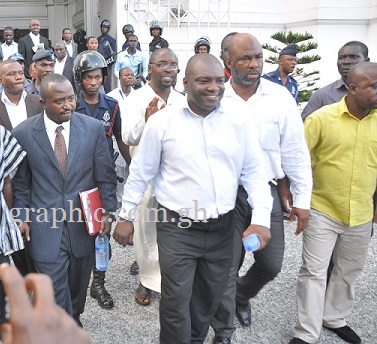 Mr
Kenneth Kuranchie (2nd right), Editor of the Daily Searchlight, and Mr
Stephen Atubiga (left), a member of the NDC communication team leaving
the Supreme Court to begin their jail terms. Picture: SAMUEL TEI ADANO
Mr
Kenneth Kuranchie (2nd right), Editor of the Daily Searchlight, and Mr
Stephen Atubiga (left), a member of the NDC communication team leaving
the Supreme Court to begin their jail terms. Picture: SAMUEL TEI ADANO Apparently fed up with the challenge to its authority and having resolved to stamp out irresponsible comments which scandalise its authority, the Supreme Court yesterday let its legal axe fall when it sentenced two persons to a total of 13 days’ imprisonment for defying its orders.
The Editor of the Daily Searchlight, Mr Kenneth Agyei Kuranchie, was sentenced to 10 days’ imprisonment, while a member of the communications team of the National Democratic Congress (NDC), Stephen Atubiga, was jailed three days.
A third person, Mr Kwaku Boahen, the Ashanti Regional Youth Organiser of the NDC, breathed an air of freedom when he was discharged following the emergence of evidence that he was innocent.
According to the court, Mr Kuranchie was given 10 days to serve in prison because he had not shown remorse for attacking the sanctity of the court, while it took into consideration the unconditional apology rendered by Atubiga and, accordingly, handed him the three-day jail term.
The court held that Kuranchie’s statement had brought the administration of justice into disrepute because it was no doubt made “to defy the authority of the court”.
With respect to Boahen, he was accused of making contemptuous statements on a private radio station in Kumasi but the New Statesman, which had published the story, retracted it and apologised to Boahen on the grounds that he had made those statements before the court’s June 24, 2013 touchline had been issued.
Guilty of Criminal Contempt
Kuranchie and Atubiga were found guilty of criminal contempt in clear contravention of the Supreme Court’s June 24, 2013 order which directed all persons to desist from making prejudicial comments and distorting facts in the ongoing presidential election petition.
They had been, in the morning of June 27, 2013, ordered to appear before the court, barely 24 hours after the court had barred the Deputy Communications Director of the New Patriotic Party (NPP), Mr Sammy Awuku, from attending the hearing of the case until the final determination of the matter for making inappropriate comments in connection with the court’s June 24 order.
Kuranchie’s Offence and Lack of Remorse
Kuranchie disapproved of the Supreme Court’s ban of Mr Awuku from the court’s sitting and also described the decision, which also warned the Daily Guide against misrepresenting facts, as hypocritical and selective.
The Editor appeared in court in the company of three lawyers — Mr Atta Akyea, Mr Yaw Owusu-Addo and Mr Kofi Boakye — but his posturing clearly indicated he stood by his words.
His bid to apologise to the court after Mr Akyea had intervened did not help matters, as he rendered a conditional apology.
Mr Akyea attempted to apologise on Kuranchie’s behalf, but the court advised him not to force his client to apologise if he was not willing to render an unqualified apology.
After 30 minutes of interaction among Mr Kuranchie, his lawyer and the court, the court went on a break and returned with its decision.
Kuranchie and Atubiga were handcuffed by policemen and whisked out of the courtroom some few minutes later to begin their sentences.
Atubiga Renders unqualified Apology
Atubiga is said to have warned that the NDC would not accept the verdict of the court if the first petitioner and 2012 presidential candidate of the NPP, Nana Addo Dankwa Akufo-Addo, was declared the President of the country.
But he rendered several apologies in the media after the court had, on June 27, 2013, summoned him to appear before it.
Atubiga looked sober and remorseful and stood with both hands behind his back and took full responsibility for what he described several times as “irresponsible” comment.
He appealed to the court to give him a “second chance at life” and stated: “There is no excuse for my mistake. I take full responsibility for my irresponsible action.”
He also admitted that he should have been more careful in choosing his words.
“I will choose my words more carefully in future,” he promised.
After answering several questions from members of the bench and describing his statement as “irresponsible” in virtually each line of his apology, Atubiga told the court he was a father and husband.
Repeat What You said and Fool’s Paradise Analogy
Asked by Mr Justice Paul Baffoe-Bonnie to repeat what he said, Atubiga said he did not have the guts to do so, adding, “I pray to God those words never come out of my mouth.”
Mr Justice Baffoe-Bonnie asked him about what had come over him when he made those contemptuous statements.
“Now look at you,” he added.
He accused Atubiga of preparing the minds of the people not to accept the court’s verdict, maintaining that “there will be a judgement, whichever way the axe falls”.
“You will live in a fool’s paradise to think we won’t give a decision. People like you cannot stop us from giving a decision,” Mr Justice Baffoe-Bonnie emphatically stated.
Staying abroad
It emerged that Atubiga had stayed in the United States of America (USA) for 14 years and that also seemed to have infuriated the bench, which held the view that people like him would bolt with their family members after their irresponsible statements had stoked conflict.
Telling the court he was once a victim of the Bawku conflict, Atubiga said he should have learnt lessons then.
He said in an answer to a question that he was not a graduate but an electrician and businessman.
Lawyers for the petitioners and the respondents, Messrs Philip Addison, James Quashie-Idun, Tony Lithur and Tsatsu Tsikata, pleaded on Atubiga’s behalf for showing remorse for his actions.
The lawyers had, earlier in a joint press briefing, expressed their resolve not to henceforth defend anybody who made irresponsible statements under the guise of politics.
Clarification on Daily Guide
Mr Justice Dotse clarified the fact that the Daily Guide was only used as an example by the court to warn the media to desist from misreporting on the ongoing petition.
He said the paper was not the only offensive newspaper, adding, “This court will be the last to gag free speech.”
He, however, reminded all that the cornerstone of every democracy bordered on “responsible and courteous” language, adding that it was unfortunate for Kuranchie to have defended a statement Mr Awuku had apologised for making.
Mr Justice Atuguba reminded stubborn politicians that the court would not renege on its resolve to restore sanity into Ghana’s body politic in order to save the larger number of Ghanaians who would bear the brunt of conflict should it arise as a result of the inaction of politicians.
The court said it was not there to harm anybody but that it would do all within its power to protect the Constitution and the interest of the ordinary Ghanaian.
Other members of the panel were Mr Justice Julius Ansah, Mrs Justice Sophia Adinyira, Ms Justice Rose C. Owusu, Mr Justice Jones Dotse, Mr Justice Anin Yeboah, Mr Justice Paul Baffoe-Bonnie, Mr Justice N. S. Gbadegbe and Mrs Justice Vida Akoto-Bamfo.
Atubiga, 2 others face Justice Atuguba - At Supreme Court today
July 2, 2013 (Lead Story)
Their names might sound similar but they live in two distinct worlds. One, by the powers vested in him and his eight other colleagues by the 1992 Constitution, is on the heels of the other, while the “hunted” has over the weekend rendered numerous apologies on various radio networks.
Ghanaians will this morning have a live view of Mr Stephen Atubiga standing before Mr Justice William Atuguba and his panel members, to render an unqualified apology to the Supreme Court for making prejudicial comments about the ongoing presidential election petition.
Mr Atubiga, a member of the communication team of the ruling National Democratic Congress (NDC), will be on the spotlight with Mr Kenneth Agyei Kuranchie, Editor of the Daily Searchlight newspaper, and Kwaku Boahen, the Ashanti Regional Youth Organiser of the NDC.
The “hunted” three were alleged to have acted in contravention of the Supreme Court’s June, 24, 2013 order which directed all persons to desist from making prejudicial comments and distortion of facts in the ongoing presidential election petition.
They were on June 27, 2013 ordered to appear before the court, barely 24 hours after the court had barred the Deputy Communications Director of the New Patriotic Party (NPP), Mr Sammy Awuku, from attending hearing of the case until the final determination of the matter for making inappropriate comments in connection with the court’s June 24 order.
 Stephen Atubiga, NDC CommunicatorOther
members of the Supreme Court panel are: Mr Justice Julius Ansah, Mrs
Justice Sophia Adinyira, Ms Justice Rose C. Owusu, Mr Justice Jones
Dotse, Mr Justice Anin Yeboah, Mr Justice Paul Baffoe-Bonnie, Mr Justice
N. S. Gbadegebe and Mrs Justice Vida Akoto-Bamfo.
Stephen Atubiga, NDC CommunicatorOther
members of the Supreme Court panel are: Mr Justice Julius Ansah, Mrs
Justice Sophia Adinyira, Ms Justice Rose C. Owusu, Mr Justice Jones
Dotse, Mr Justice Anin Yeboah, Mr Justice Paul Baffoe-Bonnie, Mr Justice
N. S. Gbadegebe and Mrs Justice Vida Akoto-Bamfo.
The Offences
Mr Atubiga is said to have warned that the NDC would not accept the verdict of the court if the first petitioner and 2012 Presidential Candidate of the NPP, Nana Addo Dankwa Akufo-Addo, was declared the President of the country.
Ken Kuranchie is being summoned before the court for a front page comment he published in the Thursday, June 27, 2013 edition of his newspaper.
For crossing the court’s final touchline which warned lawyers, journalists, political activists and social commentators to desist from making prejudicial comments about the election petition with effect from June 24, 2013, the three are expected to appear before the court by 10: a.m today.
Although the court, on the day Mr Awuku was sanctioned, warned that henceforth any other person or groups of persons who appeared before it over contemptuous comments would face harsher punishment by the court, it is not clear what the court would do to the three.
June 27, 2013 Summons
Affirming its resolve to nip in the bud loose speech and any form of write- ups that will endanger national security, the Supreme Court in the afternoon of June 27, 2013 issued written summons to the three persons to appear before it this morning.
Three separate summons, all dated June 27, 2013 and signed by the presiding judge, Mr Justice Atuguba, and the acting Registrar of the Supreme Court, Mr James Mensah, directed the affected persons to appear before the court and answer for their utterances.
Their names might sound similar but they live in two distinct worlds. One, by the powers vested in him and his eight other colleagues by the 1992 Constitution, is on the heels of the other, while the “hunted” has over the weekend rendered numerous apologies on various radio networks.
Ghanaians will this morning have a live view of Mr Stephen Atubiga standing before Mr Justice William Atuguba and his panel members, to render an unqualified apology to the Supreme Court for making prejudicial comments about the ongoing presidential election petition.
Mr Atubiga, a member of the communication team of the ruling National Democratic Congress (NDC), will be on the spotlight with Mr Kenneth Agyei Kuranchie, Editor of the Daily Searchlight newspaper, and Kwaku Boahen, the Ashanti Regional Youth Organiser of the NDC.
The “hunted” three were alleged to have acted in contravention of the Supreme Court’s June, 24, 2013 order which directed all persons to desist from making prejudicial comments and distortion of facts in the ongoing presidential election petition.
They were on June 27, 2013 ordered to appear before the court, barely 24 hours after the court had barred the Deputy Communications Director of the New Patriotic Party (NPP), Mr Sammy Awuku, from attending hearing of the case until the final determination of the matter for making inappropriate comments in connection with the court’s June 24 order.
 Stephen Atubiga, NDC CommunicatorOther
members of the Supreme Court panel are: Mr Justice Julius Ansah, Mrs
Justice Sophia Adinyira, Ms Justice Rose C. Owusu, Mr Justice Jones
Dotse, Mr Justice Anin Yeboah, Mr Justice Paul Baffoe-Bonnie, Mr Justice
N. S. Gbadegebe and Mrs Justice Vida Akoto-Bamfo.
Stephen Atubiga, NDC CommunicatorOther
members of the Supreme Court panel are: Mr Justice Julius Ansah, Mrs
Justice Sophia Adinyira, Ms Justice Rose C. Owusu, Mr Justice Jones
Dotse, Mr Justice Anin Yeboah, Mr Justice Paul Baffoe-Bonnie, Mr Justice
N. S. Gbadegebe and Mrs Justice Vida Akoto-Bamfo.The Offences
Mr Atubiga is said to have warned that the NDC would not accept the verdict of the court if the first petitioner and 2012 Presidential Candidate of the NPP, Nana Addo Dankwa Akufo-Addo, was declared the President of the country.
Ken Kuranchie is being summoned before the court for a front page comment he published in the Thursday, June 27, 2013 edition of his newspaper.
For crossing the court’s final touchline which warned lawyers, journalists, political activists and social commentators to desist from making prejudicial comments about the election petition with effect from June 24, 2013, the three are expected to appear before the court by 10: a.m today.
Although the court, on the day Mr Awuku was sanctioned, warned that henceforth any other person or groups of persons who appeared before it over contemptuous comments would face harsher punishment by the court, it is not clear what the court would do to the three.
June 27, 2013 Summons
Affirming its resolve to nip in the bud loose speech and any form of write- ups that will endanger national security, the Supreme Court in the afternoon of June 27, 2013 issued written summons to the three persons to appear before it this morning.
Three separate summons, all dated June 27, 2013 and signed by the presiding judge, Mr Justice Atuguba, and the acting Registrar of the Supreme Court, Mr James Mensah, directed the affected persons to appear before the court and answer for their utterances.
Sunday, June 30, 2013
Bench warrant for arrest of former NIB Boss
Published on www.graphic.com.gh on June 19, 2013
THE Accra Fast
Track High Court on June 19, 2013 issued a bench warrant for the arrest of the
former Managing Director of the National Investment Bank (NIB), Daniel Charles
Gyimah for failing to appear before the court on two consecutive occasions.
Gyimah was absent
when a criminal case against him was called at the court’s sitting in Accra
today. This is the second time that he has been absent in court.
Realising the
accused person and his lawyer were nowhere to be found when the case was
called, a Chief State Attorney, Mr Anthony Rexford Wiredu, prayed the court to
issue the bench warrant for his arrest.
The court,
presided over by Mr Justice Charles Quist, accordingly issued the warrant for
the arrest of Gyimah and adjourned the case to June 27, 2013.
Gyimah and the
Managing Director of Eland International, Arvind Kumar Bhatnagar, have been
charged with conspiracy, attempting to defraud NIB and forgery. Arvind is
currently being tried in absentia.
Gyimah who is on a
GH¢500,000 bail bond has pleaded not guilty to the charges.
He has been
standing trial at the Fast Track High Court since December 21, 2011.
Gyimah was alleged to have used the bank as a guarantor without the Board of Directors’ consent and issued 30 promissory notes valued at $60 million dollars in May, 2007 to a private business, Eland International (Ghana) Limited.
Gyimah was alleged to have used the bank as a guarantor without the Board of Directors’ consent and issued 30 promissory notes valued at $60 million dollars in May, 2007 to a private business, Eland International (Ghana) Limited.
The bank had
brought another witness to testify in the case but the court had to adjourn
proceedings because Gyimah was absent.
Accused persons
and their lawyers are usually required under the rules of court to be present
when witnesses are called to testify.
So far a former
Deputy Managing Director of the NIB and a former Head of the International
Banking Department of NIB have given evidence in the case.
The Facts of the Case
On February 13,
2009, Gyimah was first arraigned before the Accra Circuit Court charged with
wilfully causing financial loss of
$60 million to the state but the charges were substituted later at the Fast
Track High Court.
He allegedly
committed the offence in May, 2007 when he unilaterally used the bank as a
guarantor for Eland International (Ghana) Limited, a private company, by
signing 30 promissory notes, all valued at US$60 million.
A promissory note is a signed document containing a promise to pay a stated amount of money before a particular date.
According to the prosecution, after the accused person had signed the promissory notes, Eland, for its part, contracted US$45 million from Iroko Security Company Limited.
Iroko Security was expected to deduct the US$45 million from the US$60 million on January 1, 2009 but that did not materialise because Eland’s accounts had not been credited with the US$60 million.
The company, therefore, enquired from the NIB to confirm whether or not Eland’s accounts had been credited.
According to the prosecution, Gyimah allegedly ordered the International Banking Section of the NIB to confirm payment, which was done.
A promissory note is a signed document containing a promise to pay a stated amount of money before a particular date.
According to the prosecution, after the accused person had signed the promissory notes, Eland, for its part, contracted US$45 million from Iroko Security Company Limited.
Iroko Security was expected to deduct the US$45 million from the US$60 million on January 1, 2009 but that did not materialise because Eland’s accounts had not been credited with the US$60 million.
The company, therefore, enquired from the NIB to confirm whether or not Eland’s accounts had been credited.
According to the prosecution, Gyimah allegedly ordered the International Banking Section of the NIB to confirm payment, which was done.
Subscribe to:
Posts (Atom)