Wednesday, August 21, 2013

Sir John, Adorye summoned - Before Supreme Court on Wednesday


August 10, 2013 (Lead Story)

Justice William AtugubaJustice William Atuguba


The General Secretary of the New Patriotic Party (NPP), Mr Kwadwo Owusu-Afriyie, popularly known as Sir John, and a member of the communication team of the NPP, Mr Hopeson Adorye, have formally been summoned to appear before the Supreme Court on August 14, 2013 to answer contempt charges.
The summons, dated August 9, 2013 and jointly signed by the presiding judge of the nine-member panel hearing the presidential election petition and the registrar of the Supreme Court, Mr Justice William Atuguba and Mr James Mensah, respectively, are asking the two to show why they “should not to be committed to prison for contempt of this court for scandalising the court, lowering the authority and credibility of this court in the eyes of the general public and exciting hatred and ill-will towards the first and second respondents herein”.

The first and second respondents in the presidential election petition are President John Dramani Mahama and the Electoral Commission (EC).

Sir John, a lawyer, is alleged to have accused the Bench of being biased, while Mr Adorye is alleged to have stated that the heads of members of the National Democratic Congress (NDC) would be chopped off if President Mahama, whose Presidency is under challenge, was declared winner of the ongoing Presidential election petition.

It has been exactly a month since the Supreme Court’s attention was drawn to these alleged contemnors’ remarks.

Content of Summons for Sir John

“It having come to the notice of this court as per a publication in the “Vol. 18 No. 58, Friday 5th July, 2013” issue of the newspaper known as “THE ENQUIRER” under the banner, on the front page thereof, to wit,

“SIR JOHN DESCENDS ON JUSTICE ATUGUBA … Calls him a Hypocrite, A Joker Who Pampers Tsikata, Scolds Addison” and elaborated at page 4 thereof, that you, Kwadwo Owusu Afriyie, popularly known as “Sir John”, did on the 25th day of June, 2013 on a talk show, on Oman Fm, in the Twi language described the presiding judge of this panel “as a hypocritical joker who pampers the counsel for the National Democratic Congress, Tsatsu Tsikata, but habitually scolds the counsel for the NPP” … That the said judge habitually “frowned like a voodoo deity.”

…That “Do they think we are stupid, you sit there and frown like a voodoo deity, when Addison is talking you shut him down and beat him with sticks but when it comes to Tsatsu, when he gets angry, you ask him apologetically if he is angry. Tsikata’s cross-examination was for how many days? Didn’t Atuguba and Co see that the questions he was asking were nonsensical?”

…That “What hurts me most is that man that you call Atuguba , or Atu … Atugubu, whoever, you say he is called what?... I mean that judge, that your judge, that judge that you call Atugu… whatever, he oh he, he is funny”

…That “the Supreme Court had prepared mashed yam in palm oil (Eto, an Akan delicacy) and stuffed it with egg for Tsatsu Tsikata to eat”

… That “Justice Atuguba by his action, was up to hypocritical antics that is intended to lead to the NPP not getting the opportunity to play a tape recording of Electoral Commissioner, Dr. Kwadwo Afari-Gyan’s voice declaring that ‘No Verification, no vote’, so that the President can win the case.”

…That “Any final verdict of the Supreme Court, apart from the declaration of Akufo-Addo as winner of the elections … would amount to stealing.”

…That “To the relatives of judges sitting on the election petition, … If you have a relative who is on the panel go and tell him that you don’t want a funeral on your hands, beg him to speak the truth. …. I know the judges, they will speak the truth, but there is one or two, one particular judge who opens his mouth at anytime and the next thing you hear is a warning. I want him to know that he can’t intimidate us. I have never heard him warn Mahama.”

…That “the whole of Ghana has watched and seen that Justice Atuguba was trying to cheat the NPP, … and yet he is telling us not to complain.”

YOU, KWADWO OWUSU-AFRIYIE ARE HEREBY ORDERED to appear before this Court on the 14th day of August, 2013 at 10 O’clock in the forenoon or so soon thereafter as you can be heard to show cause why you should not to be committed to prison for contempt of this court, for thereby:
  • scandalising the court,
  • lowering the authority and credibility of this court in the eyes of the general public, and
  • exciting hatred and ill-will towards the first and second respondents herein.
Content of Summons for Hopeson Adorye

It having come to the notice of this court as per a publication in the “VOL. 3 ISSUE# 991 Monday 8th July, 2013” of the Newspaper known as “Daily Post” that you HOPESON ADORYE as per a banner on the front page thereof titled “WE SHALL CUT THE HEADS OF NDC SUPPORTERS IF…SUPREME COURT DELCLARES PREZ MAHAMA WINNER” and continuing with elaboration at page 4 thereof, did say in an interview with Time FM, Obuasi on the 26th day of June 2013 that “the NPP will … go on a head cutting spree, cutting off the heads of NDC supporters should the Supreme Court declare President Mahama the winner”,

…  That “the NPP will not accept the verdict of the Supreme Court if Akufo-Addo is not declared winner since others in the NDC have also said there will be civil war if the Supreme Court rules in favour of Akufo-Addo”,… That “the claim by fellow NPP activist, Samuel Awuku, that the Supreme Court judges were bias and are hypocrites was an appropriate comment for which Awuku should not have apologised”.

YOU, HOPESON ADORYE, ARE HEREBY ORDERED to appear before this court on the 14th day of August at 10 O’clock in the forenoon or so soon thereafter as you can be heard, to show cause why you should not be committed to prison for contempt of court, for thereby:
  • scandalising the court,
  • defying and lowering the authority of this court
  • and exciting prejudice and ill will towards the first and third respondents herein.
Background

The Supreme Court after several admonitions to the public, on June 24, 2013 issued a final warning (touchline) to lawyers, journalists, political activists and social commentators from making prejudicial comments on the ongoing presidential election petition.

Observing that the orders were not being heeded to, the court on June 26, 2013 banned the Deputy Communications Director of the New Patriotic Party (NPP), Mr Sammy Awuku, from attending the election petition hearing until the final determination of the petition.

Prior to his banishment, Mr Awuku apologised for accusing the court of being selective and hypocritical for expressing displeasure over a Daily Guide news report.

The “Silenced” Three

The Editor of the Daily Searchlight newspaper, Kenneth Agyei Kuranchie, and a Member of the National Democratic Congress (NDC) Communication Team, Stephen Atubiga, were on July 2, 2013 sentenced to 10 days and three days imprisonment respectively for falling foul of the court’s orders to persons to desist from making prejudicial comments about the ongoing petition.

They have both completed their jail terms. Atubiga is currently a peace ambassador.

The court’s final touchline warning took effect from June 24, 2013.

Thus all other persons who might have made grievous comments about the ongoing case have been spared by “statutory limitation.”

Election Petition: Judgement end of August (August 8, 2013)

From left: Nana Akufo-Addo, first petitioner; John mahama, first respondentFrom left: Nana Akufo-Addo, first petitioner; John mahama, first respondent  


The final verdict of the Supreme Court in the ongoing election petition challenging the declaration of Mr John Mahama as winner of Ghana's 2012 presidential election is likely to be delivered by the end of this month.
Mr Justice William Atuguba, President of the nine-member panel of judges hearing the case, gave the indication after lawyers for the petitioners and the respondents wound up their oral addresses yesterday.
According to Mr Justice Atuguba, the court would return on August 14, 2013 to enable the panel to ask questions and to seek further clarifications from the parties before fixing a date for the delivery of its judgement.
The Supreme Court (Amendment Rules), 2012, C. I. 74 indicates that judgement should be delivered in a presidential election petition 15 days after the close of the case.
Earlier at yesterday’s sitting, it was a battle of wits, when each of the four lawyers for the petitioners and the respondents attempted to use 30 minutes to justify why the claims of electoral irregularities in 10,119 polling stations during the presidential election should be upheld or be declined by the highest court of the land.

Case of the President
The first to address the court was lead counsel for the President, Mr Tony Lithur, who argued that the petitioners had failed to discharge the burden of proof to warrant the annulment of 3,931,339 votes.
Counsel told the court that in the heat of the voting and after it had become apparent that the biometric machines were not working, several prominent personalities, including President Mahama and other noticeable chiefs, made an appeal for qualified voters to be allowed to vote without being verified.
Following from that, he said, the EC, on December 8, 2012, allowed voting to take place at polling stations where biometric verification machines had broken down the day before.
Mr Lithur said the NPP issued press statements in which it made all manner of allegations when it emerged that it was losing the elections when the results were trickling in.
However, counsel stated that the issues the petitioners brought to court differed from the allegations they had made before the filing of the petition.

Desk-Bound Exercise
Counsel told the court that the star witness of the petitioners, Dr Mahamadu Bawumia, headed the task force which collected computers and sat in an office to begin what he termed a “desk exercise on the face of pink sheets”.
Mr Lithur said it was clear from Dr Bawumia’s evidence that there was no polling agent present during the investigations.
He submitted that no polling agent was questioned on what was found on the face of the pink sheets, adding that the petitioners “poured over paper” to make a request that votes be annulled according to evidence on the face of pink sheets.
He also made reference to what he termed Dr Bawumia’s mantra of “You and I were not there” and said such a serious exercise had been limited to the face of pink sheets.
Mr Lithur was of the view that if there were irregularities, the polling agents knew what they had to do and asked if the polling agents saw anybody voting more than once.
He said there was no claim that persons whose names were not on the voters register were allowed to vote and also asked if polling agents had seen anybody voting without undergoing biometric verification.
According to Mr Lithur, per the petitioners’ claims, they were inviting the court to ignore the role of the polling agent, as enshrined in the Constitution, as well as ignore the fact that not a single complaint was lodged at the polling station or at the constituency level.
He argued that seeing a case of over-voting on any pink sheet was clearly an error and emphasised the importance of the right to vote.
Describing allegations of some pink sheets having duplicate serial numbers as “amazing”, counsel held that polling stations were known by their names and codes.

Biometric Verification and Absence of Signatures
Responding to allegations of persons voting without undergoing biometric verification, counsel said that was not true because voting was adjourned to the next day due to the breakdown of some biometric verification machines.
He also wondered where petitioners’ polling agents were when persons were allegedly allowed to vote without undergoing biometric verification.
On the issue of absence of signatures of presiding officers, counsel said the omission of a presiding officer to sign a pink sheet should not be visited on the voter who joined long queues to vote on voting day.
Mr Lithur agreed with the assertion of the Chairman of the EC, Dr Kwadwo Afari-Gyan, that the December election was the most transparent Ghana had ever had, adding that President Mahama won “fairly and squarely”.
Counsel, accordingly, prayed the court to maintain the status quo.

The Case of the EC
Arguing for the EC, Mr Quashie-Idun made reference to Dr Bawumia’s testimony that the NPP thought it was winning on December 7, 2012 when everything changed on December 8, 2012.
After reading excerpts from the court proceedings on Dr Bawumia’s testimony, Mr Quashie-Idun said Dr Bawumia could not tell the court what actually changed after December 7, 2012.
However, counsel was of the view that nothing had changed, pointing out that the votes were counted in the full glare of the public and in the presence of polling agents.
He also argued that representatives of the various candidates were present in the strong room of the EC when results from the constituencies were presented.
Those tenets, Mr Quashie-Idun argued, were the pillars of transparency in elections in Ghana and, accordingly, prayed the court to “sceptically” look at attempts to undermine the results on the face of the pink sheets.
Touching on duplicated serial numbers on some pink sheets and the failure of presiding officers to sign some pink sheets, Mr Quashie-Idun asked, “Did presiding officers stop signing? Did serial numbers pop up?”
He made reference to Dr Afari-Gyan’s testimony that representatives of political parties were allowed 24-hour access to monitor the printing of ballot papers, among other processes leading up to the polls.
He also stated that the voters register was given to all the political parties who, in turn, gave it to their polling agents to use on election day and prayed the court to “imagine the issue of counting not taking place in public”.
Mr Quashie-Idun was of the view that Ghana’s electoral system was very transparent and said “verifiably” Ghana’s electoral system was not questionable.
He said the petitioners had not established “the casual link between their allegations, even if established, and the results as declared by the EC”.
He further held that the level of participation made it impossible to falsify results and cited the Dome Kwabenya example where an allegation of vote padding in favour of President Mahama was made.
At that constituency, Mr Quashie-Idun said, counting was done nine times and the results entered after parties were satisfied.
Counsel denied allegations of over-voting and said no ballot stuffing took place due to vigilance on the part of observers at the polling stations and added that out of the 26,002 polling stations, only one discrepancy was recorded.
That discrepancy, which involved 80 votes, according to Mr Quashie-Idun, was not enough to change the results declared by the EC.
He said the petitioners had failed to prove their case and, accordingly, prayed the court not to annul “one single vote” because there was no justification for annulment in each category.

Voters did nothing wrong
Making his submissions for the NDC, Mr Tsikata Tsatsu said the request of the petitioners for the annulment of votes must be dismissed.
Counsel said the petitioners admitted that voters did nothing wrong and further admitted that no one voted more than once and yet they were asking that valid votes be annulled.
He said the petitioners were in court to depose a “retroactive penalty” on persons who stood for hours in queues to vote.
According to counsel, the Constitution was very clear that the courts should not “countenance retroactive penalisation” and made reference to Article 42 of the 1992 Constitution which touched on the right of persons to vote.

Dr Bawumia disqualified himself
According to Mr Tsikata, Dr Bawumia disqualified himself with his “You and I were not there” assertions during his testimony on what might have happened at polling stations, adding, “He had no capacity to give testimony to seek the declarations he was seeking.”
Counsel told the court that Dr Bawumia had stated in his affidavit evidence that irregularities occurred at 11,842 polling stations and further insisted in court that he did his analysis based on 11,842 polling stations.
That claim, according to Mr Tsikata, turned out to be false after the international audit firm submitted its final report which indicated that the polling stations were not more than 8,675.
He said what was now in the closing address was 10,119 polling stations and said on the last but one day of the hearing, a figure of 10,081 was given by the petitioners.
That, according to counsel, could not be a legitimate basis to annul votes.
Counsel argued further that the court could not rely on the exhibits provided by the petitioners because they fell outside the range of the affidavit of Dr Bawumia.

Rules of Court
Counsel argued further that the rules of the court were clear and said the petitioners were required by law to provide not less than seven sets of exhibits to the justices, adding that “in many instances they have only provided one”.
He said 93 of the exhibits were not within the ‘further and better particulars’ and argued further that more than 5,000 out of the 8,000 pink sheets were not properly before the court as evidence.
Those issues, according to counsel, went to the heart of the petition, adding, “They have not even discharged the burden of evidence and the judges cannot be asked to assess those evidence.”

Over-voting
Counsel also argued that no evidence was led to prove that a person voted more than once, while Dr Bawumia acknowledged that a person could not make allegations of over-voting on the basis of what was on the pink sheets alone.
On the failure of presiding officers to sign pink sheets, Mr Tsikata said it was not fair for publicly declared votes to be annulled because a presiding officer did not sign and held further that polling agents were also required to sign the pink sheets.
According to counsel, the “most outrageous claim” was that of duplication of serial numbers, adding that it was “the weakest link in an already weak claim”.
He also accused the petitioners of selecting polling stations favourable to their case.
Urging the court to dismiss the petitioners’ claims, Mr Tsikata said, “The petitioners’ claim is factually empty, with no supportable evidence being produced. It is legally pathetic; the petition is poor in arithmetic and extremely poor in logic.”

Declare Nana Akufo-Addo President
Making a case for the petitioners, Mr Phillip Addison said the petitioners had led substantial evidence to warrant the annulment of votes in the 10,119 polling stations and the subsequent declaration of Nana Akufo-Addo as President.
He said the respondents had persistently maintained that the 2012 elections were credible and had argued for the court to uphold the results, yet when they were confronted with the pink sheets, which were the primary records of the poll, they shied away.
Counsel held that what was bizarre was that the defective pink sheets were used in the declaration of the results and submitted that Mr Tsikata had resurrected a dead issue on the number of pink sheets submitted by the petitioners.
He said according to the KPMG, 8,675 unique pink sheets in the court registrar's lot were discovered, out of which 1,545 were excluded, and upon the order of the court, 1,234 were also discovered as unique by the EC.
Mr Addison said another set of 804 pink sheets were found to be unique in Mr Justice Atuguba’s set. He said 648 pink sheets used by the respondents to cross- examine Dr Bawumia were found to be unique.
According to him, the addition of those pink sheets proved that the petitioners filed 11,000 plus pink sheets.
According to counsel, President Mahama did not win more than one per cent of the total votes and not the total valid votes cast at the election.

Difference in votes is 325,863
Counsel told the court that President Mahama beat Nana Akufo-Addo by 325,863 and said the total votes annexed by the Minority in Parliament were more than the votes annexed by the Majority in Parliament.
“For the first respondent, he garnered 5,574,761, as against 5,127, 641 by all his parliamentary candidates, which showed a difference of 447,120. What accounted for this difference? It cannot be the skirt-and-blouse phenomenon because the NDC is in the majority. The Majority in Parliament secured 121,221 votes less than the Minority. This is curious and undermines the one man, one vote spelt out in the Constitution,” Mr Addison pointed out.
He said when all the categories of violations and irregularities were combined for the 10,119 polling stations, 3,931,339 votes were deemed to be invalid, and not five million votes, as the respondents had sought to make the court believe.
He said when the results were annulled, President Mahama’s votes would be reduced by at least two million, while those of Nana Akufo-Addo would be reduced by one million votes.
He said by the computations, President Mahama would get 41.79 per cent of the valid votes cast, while Nana Akufo-Addo would have 56.85 per cent of the valid votes cast.
He said the respondents’ claim that there was no evidence of over-voting was a bit “curious.”
“Voting is a secret affair and the only time one can find cases of over-voting is only after voting had taken place and the results counted,” counsel added.

Petitioners proved infractions
Mr Addison argued that the petitioners were able to prove each infraction of over-voting, persons voting without undergoing biometric verification, presiding officers not signing signatures and duplicated serial numbers on pink sheets.
For instance, he said, the signing of pink sheets was mandatory, adding that the petitioners were able to prove that more than 900 pink sheets were not signed, aside from the 905 admitted by the EC.
He said although no explanation had been given as to why some pink sheets had duplicated serial numbers, “not a word was said about triplicate and quadruplicate serial numbers”.
That, according to counsel, was because those issues were “unanswerable”, pointing out that the petitioners were also able to prove that some polling stations with the same code but different results went into the declaration of results.

Critical admissions
Counsel said Dr Afari-Gyan made some critical admissions, including the admission which enhanced and reinforced the concept of one man, one vote.
He said Dr Afari-Gyan also told the court that he had not seen a single pink sheet before declaring the results, as well as some results in some polling stations being annulled due to infractions, among others.
He admitted that presidential election petitions in Kenya, Zambia, Sierra Leone and Nigeria had not been successful because of technicalities and the lack of numbers.
In the instance of Ghana, counsel argued that each infraction was enough to unseat President Mahama and, accordingly, prayed the court to uphold the case of the petitioners.
The petitioners want the presidential candidate of the NPP in the December 2012 presidential election, Nana Addo Dankwa Akufo-Addo, declared President on the grounds that President Mahama would not chalk 50 per cent plus one vote when invalid votes he benefited from were annulled by the Supreme Court.
By Mabel Aku Baneseh
Writer’s email: mabel.baneseh@graphic.com.gh.
 

ADB ordered to pay GHC400,000 to former MD


 August 7, 2013 (Page 26)

THE Fast Track High Court has ordered the Agricultural Development Bank (ADB) to pay GHC400,000 being the entitlements for its former Managing Director, Mr Yaw Opoku Atuahene.
It ordered that the amount must include interest since July, 2009 when the plaintiff’s appointment was wrongfully terminated by the bank.
The plaintiff sued the bank through his lawyer, Mr Godfred Yeboah Dame, for wrongful dismissal but the bank filed its response and made counter claims of fraud against him.
However, the court presided over by Mr Justice P. S. Ofei, after a full trial entered judgement in favour of Mr Atuahene and further directed the bank to further calculate the end of service benefits of plaintiff and pay same.
In the court’s considered opinion, Mr Atuahene had successfully served the bank as Managing Director and thus deserved to paid to be paid off.
The bank was also ordered to sell to plaintiff his official Mercedes Benz car at 5% of the original purchase price.
  
 The Views of the Court

Citing authorities to buttress the court’s decision, the court found as established the fact that Plaintiff had not been specifically accused of any wrongdoing by the bank before the institution of his court action.
According to the court, nothing in the purported audit report supported the bank’s contention that plaintiff had caused the crimes of causing financial loss or fraud.
The court was of the view that the supposed audit report was prepared by the ADB after Mr Atuahene’s employment as Managing Director had been terminated by the bank.
In any event, the court noted that the only findings made in that audit report were the alleged breach of administrative procedures by some of the bank’s employees.

Violation of fair hearing

Rather, the court submitted that the bank had indeed violated the plaintiff’s right to a fair hearing through the manner in which it had come out with the purported audit findings without according the plaintiff the opportunity to be heard on the adverse findings made against him.
The trial judge further found that the purported audit report clearly smacked of “mischief”, because no adverse findings were made against the plaintiff while he was in office.
The judge stated that taking into account the fact that the purported audit report was prepared after a change of government and a new board had been put in place consequent on the change, the audit report was clearly an “afterthought” and a “ploy” to deny plaintiff of his lawful entitlements.

Background

Plaintiff was the Managing Director of the bank until July 23, 2009 when his employment was terminated with effect from July 31, 2009, with the constitution of a new board after the change of government.
The plaintiff had argued that consequent to the termination his employment, various pecuniary obligations owed him by the bank were not discharged.
Plaintiff, after persistent but unheeded demands for the satisfaction of same issued a writ of summons in the Fast Track Division of the High Court on May, 21, 2010.
Reliefs sought
The financial obligations Plaintiff sued for included the determination of his end of service benefits, payment of his three months’ salary in lieu of notice, his share of the Provident Fund which consisted of his personal contributions as well as a portion contributed by defendant bank, the payment of the financial value of Plaintiff’s accumulated leave of 240 working day as well as his share of the ADB’s profit for the year 2009.
Mr Atuahene also claimed an order compelling the bank to dispose of his official Mercedes Benz car when he was using at 5% of the purchase price.
Aside denying some of the claims of plaintiff, the bank resisted other claims of plaintiff on the basis that the financial obligations owed plaintiff had been withheld as a result of the withdrawal by plaintiff and other employees of defendant, of various monies belonging to defendant and which plaintiff and those employees were yet to account for.

Counter Claims of ADB denied

In its counter claim, the bank claimed that the plaintiff and other employees of the bank connived with others and caused the withdrawal of or withdrew monies to the tune of US $ 575, 660.00 as well as GHC 101,000.
Those sums of monies, according to the bank remain outstanding and unaccounted for, and were, therefore, due from plaintiff to the bank.
The bank had also argued that these matters were duly investigated by the Internal Audit Department of the ADB, pursuant to which the Board of the bank decided to withhold the payment to plaintiff of his monetary entitlements.
Defendant, on account of the matters raised in its defence, counterclaimed that the plaintiff’s acts bordered on “deception”, “fraud” and caused a “huge loss” of US $ 575,660.00 and GH C101,000.00 to the bank.
It also demanded interest on the said amounts from the plaintiff but the bank held a different view and accordingly dismissed the counter claims.

'Legal wits' battle at Supreme Court today

Election Petition: Counsel to deliver addresses today

August 7, 2013 (Page 16)

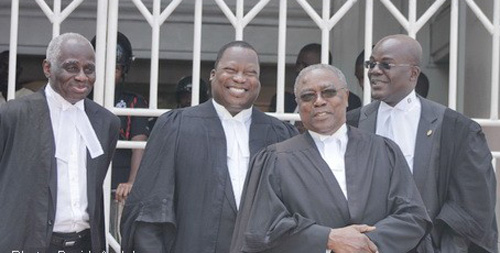
From left: Tsatsu Tsikata (Counsel for third respondent); Philip Addison, Counsel for Petitioners; Quarshie Idun; Counsel for second respondent; Tony Lithur, Counsel for first respondentFrom left: Tsatsu Tsikata (Counsel for third respondent); Philip Addison, Counsel for Petitioners; Quarshie Idun; Counsel for second respondent; Tony Lithur, Counsel for first respondent 


Ghanaians will, this morning, be treated to a “battle of legal wits” at the Supreme Court when four lead counsel in the presidential election petition meet to lock horns to justify why President John Dramani Mahama should or should not be maintained as President of the Republic.
The addresses will focus on protecting the interests of the petitioners who want President Mahama deposed on the strength of the 1992 Constitution and that of President Mahama, who was declared winner of the December 7 and 8, 2012 presidential poll.
Lawyers for the conductor of the polls, the Electoral Commission (EC), and the National Democratic Congress (NDC) will pray the court to affirm the EC’s declaration of President Mahama as the winner of the presidential election, while counsel for President Mahama will also seek to implore the court to maintain the status quo.
Barring any last-minute hitches, the oral advocacy will mark the last legal hurdle to pave the way for the delivery of the court’s judgement in the presidential election petition.
It is not clear which of the four lawyers will first address the court, but each will have 30 minutes to orally address the nine-member court, presided over by Mr Justice William Atuguba.
Other members of the panel are Mr Justice Julius Ansah, Mrs Justice Sophia Adinyira, Ms Justice Constance Rose Owusu, Mr Justice Jones Dotse, Mr Justice Anin Yeboah, Mr Justice Paul Baffoe-Bonnie, Mr Justice N. S. Gbadegbe and Mrs Justice Vida Akoto-Bamfo.

Importance of addresses
Messrs Philip Addison, James Quashie-Idun, Tony Lithur and Tsatsu Tsikata, lead counsel for the petitioners, the EC, President Mahama and the NDC, respectively, are expected to engage the court in their addresses.
Courts are usually addressed after evidence has been led in a civil or criminal case. Addresses are not compulsory, but the interest of a client can gravely be injured if a lawyer fails to address a court on issues raised during trial.
In this particular case, the addresses will focus on why votes should or should not be annulled due to over-voting, voting without biometric verification, some presiding officers not signing pink sheets (statement of poll and declaration of results form for the office of president) and some pink sheets having duplicate serial numbers.
Aside from the reliance on striking and relevant issues that may strengthen their cases, the lawyers are expected to respond to one another’s filed addresses during the oral argument.
In arriving at its decision, the court will take into account evidence before it, apply the 1992 Constitution and other statutes, as well as take into account both local and foreign authorities.

The case of the parties
The petitioners — Nana Addo Dankwa Akufo-Addo; his running mate, Dr Mahamadu Bawumia, and the National Chairman of the New Patriotic Party (NPP), Mr Jake Otanka Obetsebi-Lamptey — have alleged gross and widespread irregularities at 10,119 polling stations across the country.
They have argued that Nana Akufo-Addo should have been validly declared President on December 9, 2012 because he obtained 4,0157,12 valid votes, representing 56.85 per cent, while President Mahama benefitted from 2,622,551 votes, representing 41.79 per cent of the valid votes cast in the 2012 election.
But the respondents have denied those claims.
To buttress their claims, the petitioners have filed a 176-page address to justify the annulment of votes at the 10,119 polling stations, while the President, the EC and the NDC have filed 84, 15 and 69-page addresses, respectively, to plead with the court to maintain the said votes on the grounds that the petitioners failed to prove the allegations.

Documents before the court
Apart from the record of proceedings, each of the justices has a copy of the total of 344-page addresses, with accompanying appendices, from the parties.
The court also has in its custody five volumes of the KPMG report on the audit of the pink sheets submitted by the petitioners.
The firm presented its report on June 24, 2013.
At the same time, more than 407,000 documents, including pink sheets, sworn affidavits from witnesses of the parties, as well as other relevant documents to assist in the determination of the petition, are also before the court.

Issues for determination
Following a stalemate by the parties on issues to be set out for trial, the court, on April 2, 2013, set out two issues for determination — whether or not there were statutory violations, omissions, irregularities and malpractices in the conduct of the elections, and whether or not the said violations, omissions, irregularities and malpractices (if any) affected the outcome of the results of the elections.

The Rules and Onus of Proof
The petitioners brought the petition under Article 64 of the 1992 Constitution; Section 5 of the Presidential Election Act, 1992 (PNDCL 285) and Rule 68 and 68A of the Supreme Court (Amendment) Rules 2012, C.I. 74.
Article 64(1) of the 1992 Constitution provides: “The validity of the election of the President may be challenged only by a citizen of Ghana, who may present a petition for the purpose to the Supreme Court within twenty-one days after the declaration of the results of the election in respect of which the petition is presented,” while Article 64(2) says: “A declaration by the Supreme Court that the election of the President is not valid shall be without prejudice to anything done by the President before the declaration.’’
Part VIII of the Supreme Court Rules — Challenge Of Election of President, Rule 68 — provides: “A petition presented pursuant to Clause (I) of Article 64 of the Constitution shall state (a) the full name and address of the petitioner and of his counsel, if any, which shall be an address for service; (b) the grounds for challenging the validity of the election; (c) a statement of the facts relied on to be verified by affidavit, and of the law in support of the petition; (d) the number of witnesses to be called, if any; and by (e) such other matters as the court may determine.”
QUOTES:
Petitioners: The decision that this Honourable Court will finally arrive at will have fundamental and far-reaching consequences for the future of democracy in this country. 
It will either affirm the commitment of citizens to our democratic journey and bolster their confidence in democratic institutions and the rule of law, or undermine their belief in political and legal institutions of the nation.
It is the respectful submission of petitioners that what all citizens expect from the highest court of the land is the interpretation and enforcement of the Constitution and the law and their application to the evidence adduced in this trial without fear or favour, as the judicial oath of the learned justices of this Honourable Court requires of them.

President Mahama:  It is not Petitioner’s case that either 1st Respondent or the voters in all the polling stations where they are seeking to annul votes engaged in any wrongful acts. 
To punish voters and or annul the votes cast in all these polling stations would be to punish a large number of voters and deprive them of their inalienable right to choose their President, when they had not engaged in any wrongful act, and especially, had no control over the acts of the election officials.

EC:  My Lords, it is submitted that a pink sheet must be read as a whole and when so read, the errors it contains are discernible if one reads the form with the eye of a person desirous of conducting a careful analysis of its content as opposed to the eye of a person looking for errors and blank spaces for a possible harvest of votes for annulment.

NDC: It is our submission that the Petitioners have woefully failed to establish the alleged “irregularities, violations“ etc, nor have they proved that the alleged “irregularities, violations” etc affected the outcome of the 2012 presidential election.
We will make it abundantly clear to this Honourable Court that the case presented by the Petitioners comes nowhere close to discharging the burden of proof that lies on them to establish their allegations and warrant the reliefs they seek from this Honourable Court.
On the contrary, the documentary evidence provided by them and the oral testimony of their witness, the 2nd Petitioner, contains admissions about the results declared which fundamentally undermine the case of the petitioners and confirm the position of the respondents that the elections were conducted freely and fairly and that the results declared by the Chairman of 2nd respondent, namely that 1st Respondent was the winner of the 2012 presidential election, reflected the sovereign will of the people of Ghana and were lawful.

Petitioners hung case on administrative/clerical errors — EC


 August 5, 2013 (Page 45)

 The Electoral Commission (EC) has argued that it is impossible for errors not to occur in an election where more than 100,000 persons are trained on a temporary basis to control affairs for a short period.
“Given the fact that the EC hires over 100,000 temporary officials who are trained for only a short time to conduct the presidential and parliamentary elections in a day or two, administrative and clerical errors are unavoidable,” the EC noted in its 15-page address filed on July 30, 2013 at the Supreme Court Registry in the ongoing presidential election petition.
It added, however, that “this is not to say that the EC will not do everything in its power to ensure that such administrative errors are minimised.”
Asking for the dismissal of the petition on the grounds that it had no merit, the address filed on the EC’s behalf by Lynes, Quashie-Idun and Co. contended that if elections were allowed to be annulled “on the basis of such errors, which do not injure any candidate in particular, there would be loss of public confidence in the electoral system, and the tendency to challenge practically the results of every election will be heightened.”
Errors complained of in the election petition are over-voting, persons voting without undergoing biometric verification, failure of some presiding officers to sign pink sheets (statement of poll and declaration of results forms for the office of President) and some pink sheets having duplicate serial numbers.
The petitioners are calling for the annulment of more than three million votes in 10,119 polling stations across the country due to what they term “gross and widespread” irregularities.

Votes should be preserved
Disagreeing with the position of the petitioners, the EC said “the petitioners hung their entire case on administrative and clerical errors on the face of the pink sheets.”
According to the EC, the petitioners had failed to establish that the irregularities that occurred in the 2012 presidential election affected the results and urged the court to find that there was no justification for the annulment of any votes.
It said the right to vote was a fundamental right given by the Constitution to Ghanaian citizens who were 18 years or older, adding that in the desire to exercise their civic responsibility in relation to that right, Ghanaians spent considerable periods of time to register as voters and stood in long queues to vote on election day for the purpose of electing their leaders in accordance with the country’s democracy.
“At no time did the petitioners allege that a person voted who was not entitled to vote. Neither have the petitioners shown that any candidate or a voter engaged in wrongdoing in connection with the election. At no polling station did the number of persons who voted exceed the number of persons eligible to vote there,” it argued.

Over-voting
The address touched on each category of irregularity and argued that none of the categories could justify why votes should be annulled at 10,119 polling stations.
On the issue of over-voting, the EC held that exhibits on alleged over-voting shown to the General Secretary of the National Democratic Congress (NDC), Mr Johnson Asiedu Nketia, were different from those served on the EC.
The EC said the evidence of over-voting offered by the petitioners “on the face of the pink sheet” was based only on errors made in completing the ballot accounting part of the pink sheets.
“Further, if any over voting had occurred, it would have been detected during the counting of votes and the polling/counting agents would have protested. The evidence is that there was no such protest,” the EC added.

No signature by the presiding officer
On allegations that more than 1,000 pink sheets were not signed by some presiding officers, the EC maintained that “out of the 905 pink sheets that were not signed by the presiding officers, 99 per cent were signed by the polling agents of the petitioners.”
The address intimated that the Chairman of the EC, Dr Kwadwo Afari Gyan, admitted the obligation of the Presiding Officer to sign, but argued that polling agents signed those pink sheets and for that reason the EC considered them as acceptable for the purpose of the declaration of results.

No biometric verification
Rebutting the petitioners evidence of persons voting without undergoing biometric verification, the EC argued that the evidence presented by the petitioners for this category was “on the face of the pink sheet”.
“They did not produce a single piece of evidence of a person who saw anyone voting without having been biometrically verified,” it pointed out, adding that “most importantly, it is not disputed that there was no protest by a polling agent or any person that anyone was allowed to vote without biometric verification and the evidence of the Chairman of the 2nd Respondent was that everyone who voted was biometrically verified.”

Duplicate Serial Numbers
On the allegation of duplicate serial numbers on pink sheets, the EC said this category could properly be described as the weakest link in an already weak chain.
“The allegation that the serial number was a security feature was not substantiated. The number was inserted not by the 2nd Respondent but by the printer in circumstances that were fully explained by the Chairman of the 2nd Respondent. The Polling Stations concerned had separate identities, results and officials,” the address pointed out.

Ongoing election petition hearing at Supreme Court - Mahama genuinely won 2012 election

 August 5, 2013 (Page 47)

The National Democratic Congress (NDC) has reiterated its position that its candidate in the December 2012 presidential election, Mr John Dramani Mahama, genuinely won the election.
In a 69-page address filed at the Supreme Court registry on July 31, 2013, the party is of the view that the very petition challenging the
legitimacy of President Mahama had no leg to stand on from the day it was filed to the day the hearing of the petition ended.
"In this case the petitioners have not even crossed the threshold of discharging the evidential burden. As a result of their inability to produce material that they claimed they were supplying as evidence and because of the confused state of the material they supplied, a value of zero is the necessary outcome for the Petitioners," the NDC argued in its address.
The address, filed on behalf of the party by one of the lawyers for the NDC, Mr Samuel Codjoe, indicated that the petitioners failed to establish that there were indeed irregularities of over-voting, persons voting without undergoing biometric verification, some presiding officers not signing pink sheets and some pink sheets having duplicate serial numbers.
It drew excerpts from evidence of the witnesses in the case and relied on areas that strengthened the NDC's claim that the election was indeed free, fair and transparent.
"The documentary evidence provided by them and the oral testimony of their witness, the 2nd Petitioner, contain admissions about the results declared which fundamentally undermine the case of the petitioners and confirm the position of the respondents that the elections were conducted freely and fairly and that the results declared by the Chairman of second Respondent, namely that the first Respondent was the winner of the 2012 Presidential election, reflected the sovereign will of the people of Ghana and were lawful.
"It is our submission that the petitioners have woefully failed to establish the alleged 'irregularities, violations' etc, nor have they proved that the alleged 'irregularities, violations' etc affected the outcome of the 2012 Presidential election," the address stated.
The party also made reference to records of proceedings and evidence from witnesses in the case to prove its argument that "the case presented by the petitioners comes nowhere close to discharging the burden of proof that lies on them to establish their allegations and warrant the reliefs they seek from this Honourable Court."

No evidence of irregularities

It submitted that on a correct interpretation of constitutional provisions and other laws governing the election and having regard to the evidence before the court, the following conclusions regarding the main allegations of the petitioners emerge clearly:
Over-voting
It said there was no evidence that any voter in the election voted more than once or that any person not entitled to vote was allowed to vote, adding that "indeed, the evidence proffered by petitioners themselves showed overwhelmingly that the agents of the 1st Petitioner, as well as other agents, signed the declaration of results in the various polling stations after votes were counted in full public view."
The first petitioner is Nana Addo Dankwa Akufo-Addo, while the second and third petitioners are his running mate, Dr Mahamudu Bawumia and the Chairman of the New Patriotic Party (NPP), Mr Jake Obetsebi-Lamptey.
According to the NDC, there were no complaints by the agents of the candidates at polling stations or constituency centres regarding the allegation that over-voting was recorded anywhere.
"The claims of over-voting of the petitioners were, in large part, admitted not to hold and were abandoned by second Petitioner under cross-examination. Claims still pressed by petitioners are also untenable on a proper interpretation of information provided on the pink sheets and available evidence and must all be rejected," the party held.

Biometric Verification

The party argued that the challenges of using biometric verification devices for the first time in elections in Ghana were successfully overcome and no one voted without going through the biometric verification process.
"The testimony provided by the Chairman of the second Respondent, about the C3 column on the Statement of Poll and Declaration of Results for the office of the President forms ("the pink sheets") was unchallenged and explained the problems the Presiding Officers had in filling that part of the pink sheet," the address submitted .

No Signatures of Presiding Officers

Dismissing calls by the petitioners for the annulment of votes because of absence of signatures of the presiding officers on pink sheets, the NDC said that issue "does not justify annulment of votes that were cast lawfully in the exercise of the constitutional rights of citizens."
"While failure to sign constitutes a breach of the duty imposed on that election official by the Constitution, nowhere does the Constitution require or justify the annulment of votes cast and, hence, the results announced at the relevant polling station because of such a breach," the address pointed out.
The party was of the view that the said presiding officers could be compelled to perform their duty to sign by order of mandamus, adding that "annulment of votes in these situations would not only be an unconstitutional deprivation of the right to vote of the citizen but would also amount to punishing innocent voters retroactively for the omission of the presiding officer."
Duplicate Serial Numbers on Pink Sheets
According to the NDC, serial numbers were not, and had never been, security features on pink sheets, unlike ballot papers and argued that "the petitioners have provided no legal basis for this category of their claim.


Dismiss petitioners’ case - Lawyers for President Mahama declare

August 2, 2013 (Page 26)


From Left: Tsatsu Tsikata, Tony LithurFrom Left: Tsatsu Tsikata, Tony Lithur 


Lawyers for President John Dramani Mahama, have called on the Supreme Court to dismiss the case of the petitioners in the ongoing presidential election petition because they have failed to prove their allegations.
They submitted that the refusal or neglect of the petitioners to file any complaints relating to the alleged irregularities at the various polling stations and collation centres should ordinarily have denied them the opportunity to invoke the jurisdiction of the Supreme Court under Article 64 of the 1992 Constitution.
This was contained in an 84-page address the lawyers presented to the court on Tuesday, July 31, 2013.

Address on behalf of President
According to the document, it was patently clear from the history of the case that the petitioners failed to make a case for the occurrence of the alleged irregularities at the various polling stations nationwide and to provide the EC with the opportunity to deal with those allegations administratively and on the spot because they simply lacked the evidence to back their claims.
“So the strategy they adopted was simply to trigger the jurisdiction of this court by filing a petition and then go back to look for the evidence,” the document held.

Biometric Verification
On biometric verification, the document said the burden lay on the petitioners to prove by credible evidence that, indeed, people voted at the various polling stations without having undergone biometric verification.
It submitted that proof could not be limited to pink sheets but must relate to actual events at the affected polling stations, testified to either orally or by affidavit by persons who were allowed to vote without biometric verification or persons who were witnesses to such occurrences.
“This is particularly so since the respondents have strongly denied this allegation and there are patent clerical errors in the C column of the pink sheets,” it said, adding that “no such evidence outside of pink sheets was proffered by the petitioners in support of their claim”.

Over-voting
On over-voting, the document said electoral irregularities and malpractices could not be left to be defined either by the parties to electoral disputes or even by the court.
“In a truly democratic society, such irregularities and malpractices are stipulated in laws duly enacted by the authorities invested with the power to make laws and regulations, so that all actors in the democratic process have foreknowledge of what may or may not constitute an infraction,” it said.
According to the document, given that there was no common law basis for contesting an election, the parties to such a contest derived their right to participate in the contest and to contest the outcome from the legislative scheme put in place by Parliament.
It said in order to discharge their burden of proving that over-voting occurred at a particular polling station, the petitioners must have led evidence to show that one or more of those incidents occurred at the affected polling stations, in respect of which they had complained in prescribed manner.
That, it said, could be done by affidavit evidence, as ordered by the court, by oral testimony or, indeed, by exhibiting, for instance, an irregularity form duly filled.
Touching on the absence of the signature of presiding officers on pink sheets, the document submitted that a presiding officer who omitted to sign a declaration form was compellable in law to perform those duties.
It said had the suggestion been made that the failure to sign was wilful, then such a presiding officer would have committed an electoral offence for which he would be subject to criminal sanction.
That notwithstanding, it said, the effect of failure to sign the declaration form should not be that the results the presiding officer had declared should be annulled, unless the suggestion was that his failure to sign affected the results.

Duplicate Serial Numbers
On duplicate serial numbers, the document said Dr Mahamudu Bawumia’s evidence-in-chief on alleged irregularities did not state the exact nature of the malpractice or irregularity that had been occasioned by the use of the duplicate serial numbers on the pink sheets.
It said the testimonies of Dr Afari-Gyan and Mr Johnson Asiedu Nketia regarding the processes surrounding security items in the electoral process should have informed petitioners about the futile nature of their claim, since they could not claim ignorance of the requirement of serial numbers on ballot papers.
“At least the first and third petitioners have been part of this electoral system for years. Inventing such a claim is, therefore, an act of bad faith. It was an invention by petitioners to bolster their case and should be wholly dismissed as adventurous,” it noted.

Ongoing election petition - We have enough evidence to obtain favourable judgement - Petitioners

 August 2, 2013 (Page 23)


Philip Addison, lead Counsel for PetionersPhilip Addison, lead Counsel for Petioners 


The petitioners in the 2012 presidential election challenge say that they have succeeded in producing a “mountain” of evidence sufficient enough to discharge the burden of proof placed on them and to obtain a favourable decision from the Supreme Court.
According to them, the evidence they had adduced at the close of trial remained unchallenged in all material effects.
These sentiments were contained in the address of counsel for the petitioners which was submitted to the court on Tuesday, July 30, 2013.

The Address
The petitioners’ address said, among many other things, that to prosecute their case, they filed and relied on 10,119 pink sheets which spoke to the nature of the violations, malpractices and irregularities grounding the petition.
According to the 176-page document, the respondents, on the other hand, failed or refused to file any pink sheet, except the 17 pink sheets the Electoral Commission (EC) was compelled to tender in evidence on the penultimate day of trial in an attempt to rebut damning evidence led against it.
“This was so, even though the EC is the body constitutionally mandated to conduct public elections and referenda, and notwithstanding the fact that it is the official custodian of the pink sheets in the election,” it said.
It said beyond reliance on inconsequential reports of election observers, the respondents, in effect, tendered no evidence of substance of their own, adding that they all sought to whittle down and reduce the number of pink sheet exhibits the petitioners had filed on technical grounds of defects in the labelling of the pink sheet exhibits.
“They seized the slightest occasion to hurl baseless attacks of criminality, forgery, the manufacturing and smuggling of pink sheets into evidence, even though unsubstantiated, on petitioners,” it said.
According to the document, the Chairman of the EC, who was the returning officer of the presidential election, “with respect”, cut an unconvincing figure with his evasive, inconsistent and contradictory answers during cross-examination, pointing out that “his credibility by the end of the trial was all but gone”.
It said the petitioners had shown, by the sheer depth and weight of the evidence adduced at the trial and the force of legal arguments advanced in the address that there had, indeed, been substantial constitutional and statutory violations, malpractices and irregularities in the 2012 presidential election and that those violations, malpractices and irregularities had a material effect on the results of the election as declared by the EC.

Court’s Decision
The document said the decision that the Supreme Court would finally arrive at would have fundamental and far-reaching consequences for the future of democracy in the country.
“It will either affirm the commitment of citizens to our democratic journey and bolster their confidence in democratic institutions and the rule of law or undermine their belief in the political and legal institutions of the nation,” it held.
According to the document, what all citizens expected from the highest court of the land was the interpretation and enforcement of the Constitution and the law and their application to the evidence adduced in the trial without fear or favour, “as the judicial oath of the learned justices of this Honourable Court requires of them”.
“It is, accordingly, the respectful submission of petitioners that a case worthy of all the reliefs that they seek has been made out,” it added.
It said the Constitution insisted that only valid votes be taken into account in the determination of the validity of the election of the President of the Republic.
“That is the clear teaching of Article 63 (3). The consequence is that if the invalid votes, totalling 2,622,551, attributed to the first respondent are taken out of  5,574,761 votes declared for him,  the total valid votes the first respondent, in fact and in law, obtained are 2,952,210, representing 41.79 per cent of the valid votes cast in the 2012 election.
“The declaration made on 9th December, 2012 by the second respondent and set out in the Constitutional Instrument of the President Elect Instrument, 2012 (CI 80), made under the hand of the chairman of the second respondent, was, therefore, made wrongfully and this court is respectfully invited to hold that his election was invalid and to set aside same as null and void.
“In the premises, this Honourable Court is respectfully invited to hold that the first petitioner, having obtained 4,0157,12 valid votes cast, as a result of the annulment of 1,233,186 invalid votes from the figure of 5,248,898 declared for him by the second respondent, resulting in first petitioner obtaining 56.85 per cent of the valid votes cast, should be declared by this Honourable Court as the winner of the 2012 presidential election,” the document further submitted.

Categories of irregularities at 10,119 polling stations
• Over-voting affected 1,722 polling stations, while voting without biometric verification occurred at 2,020 polling stations.
• The irregularity of absence of presiding officers’ signature occurred at 638 polling stations.
• Use of duplicate serial numbers on pink sheets affected 8,987 polling stations.
• The analyses of the petitioners are all backed by details of the polling stations, including polling station names, polling station codes, pink sheet serial numbers and votes secured by the various candidates at the various  polling stations contained in Volume 2 of the addresses submitted.
• The petitioners also showed in their addresses that all the four main irregularities on their own had a material impact on the results declared and that annulling the polling stations affected by any of the four irregularities would mean that the declared winner, John Mahama, did not secure the required over 50 per cent.

Lawyers to give oral addresses - In election petition on August 7

  August 1, 2013 (Lead Story)


From left: Tsatsu Tsikata, Philip Addison, Quarshie Idun, Tony LithurFrom left: Tsatsu Tsikata, Philip Addison, Quarshie Idun, Tony Lithur 


Lawyers in the presidential election petition have been granted permission to give oral advocacy for and against the maintenance of Mr John Dramani Mahama as the President of the Republic of Ghana.
They have been allotted 30 minutes each to make their oral addresses on August 7, 2013. Hearing might resume on August 8, 2013 in the event August 7, 2013 turns out to be a public holiday marking the end of the Muslim month of Ramadan.
According to the Supreme Court, the addresses could be by way of clarifications and necessary additions.
The additions could include responses from the parties to each other’s address.
Oral arguments will be made for and against calls for the annulment of votes due to allegations of persons voting without undergoing biometric verification, over-voting, some presiding officers not signing pink sheets (statement of poll and declaration of results form) and some pink sheets having duplicate serial numbers.
By the court’s orders, Messrs Philip Addison, James Quashie-Idun, Tony Lithur and Tsatsu Tsikata, lead counsel for the petitioners, the Electoral Commission (EC), President Mahama and the National Democratic Congress (NDC) respectively, are expected to address the court to justify why the President should be maintained or changed.
The presiding judge of the nine-member panel, Mr Justice William Atuguba, gave the directive after it emerged that all the parties had filed their written addresses as directed by the court.
Other members of the panel are Mr Justice Julius Ansah, Mrs Justice Sophia Adinyira, Ms Justice Rose Constance Owusu, Mr Justice Jones Dotse, Mr Justice Anin Yeboah, Mr Justice Paul Baffoe-Bonnie, Mr Justice N. S. Gbadegbe and Mrs Justice Vida Akoto-Bamfo.
Addresses are usually filed by parties in a legal dispute after evidence has been led. They normally contain analysis or summary of evidence.
The crux of addresses is to enable parties in a case to lead arguments in their bid to convince the court on why their request must be granted. It also allows parties to find faults with each other’s case and submit on them accordingly.

Late NDC allowed to file its address
The petitioners, the President and the EC complied with the court’s July 17, 2013 orders and filed their written addresses on July 30, 2013 but the NDC could not meet the court’s deadline.
Following from that, the party filed its written address at the Supreme Court registry at 9:50 a.m. on Wednesday and subsequently, Mr Tsikata announced at the court’s sitting that his side was seeking leave to file its address.
Counsel explained that he had mechanical challenges in binding the address, which had more than 10 appendices for the court’s convenience.
Mr Tsikata further stated that he underestimated the timing and as a result he could not meet the court’s deadline, but the petitioners and the bench did not take kindly to his explanation.

‘Communist inferior tactics’
Raising an objection to the late filing of the address, Mr Addison reminded the court that court orders were meant to be obeyed.
According to counsel, the proper thing for Mr Tsikata to have done was to formally inform the court that his side was not in the position to file the address at the time directed by the court.
Mr Addison contended that the court’s orders were explicit to the effect that parties were directed to simultaneously file their addresses and indicated that from the look in the eyes of Mr Tsikata, he “spent all night going through our address”.
He said the attitude of Mr Tsikata amounted to “Communist Inferior Tactics,” and added that with the elimination of Communism, he least expected such behaviour from Mr Tsikata.

'I had a very long sleep'
In response, Mr Tsikata told the court that he in fact had a “very long sleep” and added that he had “up till now” not seen a copy of the petitioners’ address.
He also took full responsibility for the late filing of the address and reiterated that the address was ready on Monday, but for the challenges in the binding.
Mr Tsikata did not take kindly to Mr Addison’s insinuation that he had had the opportunity to study the petitioners’ address.
Mr Justice Atuguba, however, directed him to withdraw his comments which the court found offensive, to which Mr Tsikata obliged.

Bench not happy but allows filing of address
Comments from Ms Justice Rose C. Owusu, Mr Justice Atuguba and Mr Justice Jones Dotse clearly indicated that the bench was not amused by Mr Tsikata’s late submission of the address.
In a terse ruling, the court was of the view that much as the delay in meeting its deadline was to inure to the benefit of the bench, the court’s orders must not be taken lightly by parties.
The bench also took note of the gravity and longevity of the case and the fact that the “sins of counsel” should not be visited “on the head of the client”, and accordingly admitted the address.