Monday, May 27, 2013

Three MPs join National Media Commission

 May 22, 2013 (Page 18)

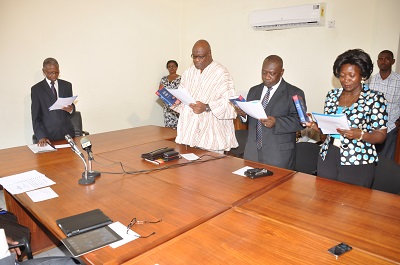
Justice Joseph Akamba (extreme left), a Supreme Court Judge, swearing in new members of the National Media Commission (NMC) at a ceremony in Accra. From right are Mrs Della Sowah, Mr O.B. Amoah and Mr Fritz Baffuor.  Picture: SAMUEL TEI ADANOJustice Joseph Akamba (extreme left), a Supreme Court Judge, swearing in new members of the National Media Commission (NMC) at a ceremony in Accra. From right are Mrs Della Sowah, Mr O.B. Amoah and Mr Fritz Baffuor. Picture: SAMUEL TEI ADANO
A Supreme Court Judge, Mr Joseph Bawah Akamba, has deplored the abuse of freedom of expression by sections of the media.
Reminding journalists that freedom worked in consonance with responsibility, Mr Justice Akamba said “over the years serious concerns have been raised about media tyranny and near anarchy, “ and accordingly urged media owners to use their platforms to promote development in the country.
Addressing newly appointed members of the National Media Commission (NMC) in Accra yesterday after swearing them in, Mr Justice Akamba held that, “while censorship is no option to consider, the daily infractions, the vitriolic personality attacks and the publication of calumnious and inexcusable falsehoods should awaken the Commission to the need for the media to regulate itself.”
Three members of Parliament, namely  the Member of Parliament for Ablekuma South, Mr Fritz Baffour, the Member of Parliament for Akuapim South, Mr O. B. Amoah,  and  the Member of Parliament for Kpando,  Mrs Della Sowah, were nominated by the Speaker of Parliament and accordingly sworn in to assist in the operations of the NMC.
According to Mr Justice Akamba, the time had come for the NMC and the Ghana Journalists Association (GJA), to work in conjunction with Parliament to facilitate the passing of the Broadcasting Law.
“The real challenge for the media is how to develop content that is relevant to the needs of our people. Media owners should spend some time and money in developing appropriate content that will elevate public discussion on the issues that confront our people, make our people dream and fire their imaginations to do great things for the country, before rushing to collect licences to operate radio and television stations,” Mr Justice Akamba said.
He advised the newly sworn in members to shed their “political garb” and expressed the hope that their performance would bring honour to themselves, their families and the society as a whole.
The Chairman of the NMC, Mr Kabral Blay- Amihere, advised the media to preserve the peace and unity of the nation through an unbiased coverage of proceedings at the ongoing electoral petition challenging the legitimacy of President John Dramani Mahama.
“Neither should the media allow their platforms to be used by others to generate tensions nor false expectation about the case before the Supreme Court,” Mr Blay Amihere stressed.
He further urged the media to allow the Supreme Court to “perform its historic duty” without subjecting the highest court of the land to any form of intimidation.
“It is our hope that the Ghanaian media in their role as reporters and gatekeepers will pass the test of objectivity, accuracy and truthfulness in these trying times,” the NMC Chairman continued.
He took the opportunity to highlight the challenges faced by members of the NMC and accordingly, pleaded with the Controller and Accountant General Department and other government agencies to address those challenges.
For instance, he stated that members of the Commission had for the past eight months not been paid their allowances, adding that members of the fifth and sixth Commission of the NMC, had still not been paid as holders of national posts under Article 71 of the 1992 Constitution.
Mr Amihere admonished the government to find innovative ways of resourcing the national the Ghana Broadcasting Corporation (GBC), who he said was currently losing out on revenue due to the live coverage of the electoral petition.
The NMC Chairman disclosed that the NMC would continue to engage the government for the establishment of the Media Fund to promote a free and independent media.
Delivering a short address on behalf of his colleague MPs, Mr Baffour said he and the other MPs would support the NMC to ensure sanity prevailed in the activities of the media.
He accordingly appealed to media organisations to refrain from using their platforms to abuse freedom of speech.

Friday, May 24, 2013

Ongoing election petition - PARTIES FIGHT OVER BOXES - Containing pink sheets

May 21, 2013 (Lead Story)

CONTROVERSY has rocked the auditing of pink sheets, as lawyers for President John Dramani Mahama and the National Democratic Congress (NDC) have objected to alleged introduction of additional boxes containing pink sheets.
But a former Deputy Attorney-General and Minister of Justice, Ms Gloria Akuffo, who is leading the petitioners legal team, has refuted allegations that extraneous materials had been introduced into the pink sheets.
A statement signed by the General Secretary of the NDC, Mr Johnson Asiedu-Nketiah and issued in Accra said, “in respect of the count of exhibits ordered by the Supreme Court, Counsel for the President and the NDC have objected to an attempt to introduce additional boxes of exhibits which were not part of the exhibits inspected by all parties prior to the commencement of the counting exercise.”
 “Together with Counsel for the Electoral Commission a representation was made to the Deputy Judicial Secretary for the suspension of the count pending further orders of the court.  Counsel have also asked for improved security for the exhibits in order not to compromise further the integrity of the process,” the statement said.
It has accordingly requested NDC supporters to remain calm while the court resolved the issue.
Petitioners Rebuttal
But in a sharp rebuttal, Ms Akuffo said the respondents were making false allegations because nothing of such nature happened at the Supreme Court conference room. 
According to her, officials of the Supreme Court registry, KPMG officials and all representatives of the parties were present at the Supreme Court conference room when the audit was ongoing.
She, therefore, wondered why the respondents did not protest in the morning when issues had to be trashed out before the actual audit began through to the afternoon when the protest was lodged.
Ms Akuffo said the counting would probably have ended on Wednesday and now “they are running away,” adding that, “we did not ask for the audit. If they are willing to go on, our representatives are ready for the audit to continue.”
Supreme Court Sources Mute
Sources at the Supreme Court have declined to comment on the raging controversy and explained that the issues would be resolved at the court today.
The nine-panel members, who have now been labeled as “nine wisemen” are expected to deliberate over the issue and resolve it when it is officially brought to their attention this morning.
The court, which has Mr Justice William Atuguba as the President, is expected to resolve the controversy.
Other members of the panel are Mr Justice Julius Ansah, Mrs Justice Sophia Adinyira, Ms Justice Rose Owusu, Mr Justice Jones Dotse, Mr Justice Annin Yeboah, Mr Justice Paul Baffoe-Bonnie, Mr Justice N. S. Gbadegbe and Mrs Justice Vida Akoto-Bamfo.
KPMG’s Explanation
A Senior Partner of KPMG, the international audit firm which was appointed by the Supreme Court to conduct audit into the pink sheets, Mr Joe Winful, told the Daily Graphic that representatives of the petitioners and the respondents had been invited to a meeting at the Supreme Court today, to resolve the issue.
Mr Winful explained that the auditing started on Monday and that in the middle of it, representatives of the NDC and the President demanded that the auditing be stopped.
According to him, the auditing stopped, and parties have been invited to the Supreme Court to resolve their differences today.
He made it categorically clear that the KPMG was only a referee, and for that matter a neutral body in the dispute.
“We are referees sitting on the touchlines and watching. We are working on documents that have been given to us by the Supreme Court and nobody else,” Mr Winful said.
 He reminded all that his outfit had and would continue to perform the role assigned to it by the Supreme Court in the presence of all parties in the electoral petition.
KPMG has agreed to conduct the audit for free, thereby putting to rest speculations that the company was to conduct the audit for a fee of $100,000.
Genesis of Pink Sheet Controversy
Disagreements surrounding the number of actual pink sheets submitted by the petitioners have kept popping up during the interlocutory stage of the hearing of the electoral petition at the Supreme Court.
The petitioners have since the beginning of the hearing, deleted 704 pink sheets and are currently relying on 11,138 pink sheets in their final analysis.
Counsel for the President, Mr Tony Lithur, for instance has argued that he received 8,579 pink sheets, while counsel for the NDC, Mr Tsatsu Tsikata, said his client had taken custody of 8,000 pink sheets served on it by the registrars of the court.
The conductor of the polls, the Electoral Commission (EC), which is the third respondent in the case, has not come out clearly on the number of pink sheets it has received but its lawyer, Mr James Quashie-Idun, has also informed the court his client had received less than 11,842 pink sheets.
Following the tenacious disagreement between parties on the actual number of pink sheets submitted to the court – the court, on May 9, 2013, in consultation with parties in the case, ordered that an audit be conducted into the pink sheets.
The Audit
A number of meetings were held between representatives of the petitioners and the respondents to agree on the modalities to be adopted to pave the way for the audit to begin at the conference room of the Supreme Court on Monday, only for more controversy to emerge.
The Petition
The hearing of the substantive petition, which has the presidential candidate of the New Patriotic Party (NPP), Nana Addo Dankwa Akufo-Addo, his running mate, Dr Mahamudu Bawumia and the Chairman of the NPP, Mr Jake Obetsebi-Lamptey, as petitioners began on April 17, 2013.
Dr Bawumia, who is the star witness for the petitioners, has since been led by Mr Philip Addison to complete his evidence-in-chief. He has been cross examined by the lawyers for the President, Mr Tony Lithur and Mr Quashie-Idun.
He is currently undergoing cross-examination from Mr Tsikata, who maintains that Dr Bawumia has duplicated pink sheets to deceive the court.
However, Dr Bawumia has denied that assertion and argued that nowhere did the petitioners duplicate pink sheets in the final analysis of the alleged widespread and gross irregularities in the December 2012 presidential elections, which is on a CD-Rom.
Mr Tsikata, has been cross examining Dr Bawumia for the past 12 days.
The petitioners have alleged that the December 7 and 8, 2012 presidential election was fraught with malpractices of over-voting, non-signing of pink sheets by presiding officers or their assistants, voting without biometric verification and duplicated serial numbers of pink sheets.
However, President Mahama, the EC and, the NDC have denied that any such irregularities occurred during the election.

Election Petition: Court restrains respondents from cross-examining four witnesses


Mr Justice Atuguba, President of the nine-member panelMr Justice Atuguba, President of the nine-member panel
The Supreme Court has refused a request from the respondents in the presidential election petition to cross-examine four witnesses who have given evidence in the form of sworn written affidavits.
According to the court, it had received and was still in the process of receiving abundant evidence from the parties in the dispute to enable it to arrive at a conclusion in the petition challenging the legitimacy of President John Dramani Mahama.
In a unanimous decision, the court refused to grant the prayer of President Mahama, the National Democratic Congress (NDC) and the Electoral Commission (EC) which sought leave of the court to cross-examine the four witnesses.
According to the court, various types of evidence had been filed, while one of the petitioners, Dr Mahamudu Bawumia, had given his evidence-in-chief and was in the process of being cross-examined, adding that further evidence to be adduced by other witnesses was enough for the court to draw a conclusion.
The evidence before the court includes 11,138 pink sheets filed by the petitioners who are alleging gross and widespread irregularities, an 83-paragraphed affidavit sworn by Dr Bawumia, six additional affidavits sworn by witnesses for the petitioners, more than 7,000 affidavits from witnesses for the President and the NDC and
several affidavits and supplementary affidavits from the EC.
In the court’s view, the filed affidavits, evidence-in-chief from parties in the case, lengthy cross-examination and re-examination as the case progresses were more than enough for it to make a definite decision on the matter.
The ruling, which took less than five minutes, was read by the President of the court, Mr Justice William Atuguba.
After the court’s ruling, counsel for the President, Mr Tony Lithur, enquired whether or not the respondents could cross-examine the witnesses the petitioners had recommended could be cross-examined, but Mr Justice Atuguba said the ruling applied to the other witnesses and added, “The evidence is flowing.”
The other members of the panel are Mr Justice Julius Ansah, Mrs Justice Sophia Adinyira, Mrs Justice Rose Owusu, Mr Justice Jones Dotse, Mr Justice Annin Yeboah, Mr Justice Paul Baffoe-Bonnie, Mr Justice N. S. Gbadegbe and Mrs Justice Vida Akoto-Bamfo.
The Four Witnesses
The four, in their affidavit evidence dated April 7, 2013, had laid claim to the fact that votes were annulled because over-voting and/or voting took place without biometric verification.
They are the Member of Parliament (MP) for Berekum East, Dr Kwabena Twum Nuamah; the NPP’s parliamentary candidate for Upper West Akyem in the Eastern Region, Mr Eugene Sackey; the NPP MP for Tano North, Ms Freda Prempeh; a resident of Savelugu, Fuseini Safianu, and the presiding officer of Temporary Booth Chief’s palace polling station at Pong Tamale, Abdulai Abdul Hamid.
Although lead counsel for the petitioners, Mr Philip Addison, had opposed moves to cross-examine the four on the grounds that the issues they had sworn to were not in contention, he was not against the calling of Safianu and Hamid for cross-examination.
Case of the Respondents
Moving the motion earlier, Mr Tsikata had said per the court’s April 2, 2013 ruling, it would serve the interest of justice if it ordered that the four be cross-examined.
Coming under Rule 69 (c) 8 of the Supreme Court Amendment Rules, 2012 (C I 74), which indicates that a person who has sworn an affidavit may be cross-examined by a party after the party had sought leave of the court to cross-examine, counsel argued that the respondents were not seeking to cross-examine all the six additional witnesses of the petitioners but were focusing on relevant matters averred to by the witnesses.
What the respondents were seeking to do, he explained, was to test the truthfulness of witnesses’ evidence to enable the court to arrive at its conclusions.
According to counsel, the rules of evidence under which the court operated also made it clear that the issue of cross-examination was essential to the full determination of a trial.
He said Section 62 (2) of the Evidence Decree of 1975 did not give parties the choice to determine which witnesses to be or not to be cross-examined.
Counsel held that there was no allegation that the witnesses were not available for cross-examination, and for that reason the court might want to wonder why the petitioners were seeking to protect witnesses from cross-examination.
Mr Tsikata argued that the evidence of the star witness of the petitioners, Dr Bawumia, which had been challenged by the respondents, also sought to rely on the evidence of the said four witnesses.
“The witnesses also claim to have personal knowledge of matters they deposed to and there is, therefore, no basis for them not to be directed to appear in court for cross-examination,” he pointed out.
Counsel opined that Sackey and Prempeh were parliamentary candidates in the December 2012 elections and had testified to the issues that occurred at polling stations and collation centres and for that reason their testimonies were crucial to the final determination of the matter before the court.
He said if, indeed, those witnesses were at the said polling stations and collation centres, it was important for them to be cross-examined to enable the court to arrive at the truth.
“Our submission is that the processes of the court will be well served by obtaining testimony from people who
claim to have personal knowledge from facts deposed,” Mr Tsikata said.
He argued that neither the President nor the NDC could be held to an answer allegedly provided by the EC in reference to claims by some EC witnesses that votes were cancelled in some polling stations because of over-voting and voting without verification.
Contesting the claims to the alleged admission of certain facts by the EC, Mr Tsikata said the NDC and the President would cross-examine on them.
"The interest of justice and fairness will be served if the court allows the respondents to cross-examine the four witnesses," Mr Tsikata held.
Responding to the claim by the petitioners that the calling of the four witnesses would lead to delays in the trial, counsel argued that that claim was “extraordinary” because the respondents were entitled to cross-examine witnesses.
Mr Lithur and Mr Quashie-Idun associated themselves with Mr Tsikata’s submissions.
Mr Philip Addison’s opposition
Mr Addison opposed the call to cross-examine Dr Nuamah, Sackey, Prempeh and Peter Wuni, the NPP parliamentary candidate for Nalerigu-Gambaga in the Northern Region.
However, he did not oppose the cross-examination of  Hamid and Safianu, adding that the April 2, 2013 court order was made to facilitate the expeditious hearing of the petition.
According to counsel, the four witnesses gave evidence based on what had transpired at the various polling stations and collation centres where they were present and further indicated that the EC had, indeed, corroborated their evidence, and for that reason there were no issues in controversy to warrant their being called for cross-examination.
For instance, counsel said Prempeh’s evidence attested to the fact that there was cancellation of ballots at the Methodist Primary Polling Station, Tanoso, because there was one vote less in the presidential ballots and a vote more in the parliamentary ballots, while Dr Nuamah said results were annulled at the Roman Catholic Church, Kutre Number One Polling Station because some voters voted without biometric verification.
He also recapped the names of EC witnesses who had also testified in the form of affidavits that some votes were annulled due to over-voting and voting without biometric verification.
Mr Addison argued that nowhere did the President and the NDC challenge the annulment of votes as deposed by the EC, adding, “We need to move forward. It will not serve a useful purpose to allow them to cross-examine on matters that are no longer in controversy.”
“I am happy the issue has been confirmed by the EC. There is consistency here,” he said, in reference to EC’s averments that some votes were cancelled due to over-voting and voting without biometric verification.
Tsikata's Issues on law
In his reply, Mr Tsikata said CI 74 was aimed at ensuring an expeditious trial and not to set aside the rules of evidence and procedures of court, adding, “The allegation of delay is disingenuous because Mr Addison is choosing who and who to be called and not to be called to testify.”
Mr Tsikata’s cross-examination of Dr Bawumia resumed after the court’s ruling, during which witness admitted that some polling stations had been repeated in the exhibits submitted to the court but explained that the final analysis did not include the duplications.
There was a back and forth interchange among the bench, Mr Tsikata and Mr Addison following Mr Tsikata’s refusal to tender in evidence exhibits provided by the petitioners as a result of his request for them.
Mr Tsikata had, on the previous adjourned date, requested for a list of polling stations where the petitioners claimed the same serial numbers were duplicated on many pink sheets for countless different polling stations across the country.
The petitioners provided the full list of more than 2,000 polling stations to Mr Tsikata yesterday, but Mr Tsikata refused to tender the list in evidence before cross- examining Dr Bawumia on them.
Instead, he listed 20 out of the 2,000 polling stations submitted by the petitioners and planned to cross-examine on them and then move into other areas later, but the bench and Mr Addison wondered why he had taken that decision.
Mr Addison insisted that Mr Tsikata tender the document in evidence before cross-examining the witness on it, but Mr Tsikata said he only sought to cross-examine on areas relevant to his client’s case and for that reason he was not going to tender the document in evidence.
Mr Justice Atuguba said Mr Tsikata’s stance was “puzzling”, while Mr Justice Jones Dotse implored him to tender the full document, since the court did not have the list to make reference to.
On realising that Mr Tsikata would not budge, the panel entered into a split decision and accordingly held that Mr Addison was at liberty to tender the list of the 2,000 polling stations during the re-examination of Dr Bawumia.
‘Mind your language’
Mr Tsikata then expressed wonder as to the way and manner the court was proceeding, but Mrs Justice Vida Akoto-Bamfo enquired whether Mr Tsikata was getting angry.
She then advised him to mind his language, but Mr Tsikata later explained that he did not intend to malign the bench.
After the court’s decision, Mr Tsikata then pulled a list of 20 polling stations from his file and sought to cross-examine Dr Bawumia on them, but Mr Addison opposed the move and said he did not see why Mr Tsikata should cross-examine on documents which did not have primary sources.
According to Mr Addison, what Mr Tsikata was seeking to tender was from the original list the petitioners had provided to him.
Mr Tsikata responded and said the source of his document was the pink sheets.
The court is expected to rule on the issue on Monday, May 20, 2013.
The Petition
The petitioners filed the petition on December 28, 2012 and alleged that the December 7 and 8, 2012 presidential election was fraught with malpractices of over-voting, non-signing of pink sheets by presiding officers or their assistants, voting without biometric verification and duplicated serial numbers of pink sheets.
However, President Mahama, the EC and the NDC have denied that any such irregularities occurred during the election.

Auditing of pink sheets - IT'S FREE - KPMG tells court

 May 16, 2013 (Lead Story)

The international accounting firm, KPMG, which has been appointed by the Supreme Court to conduct an audit of pink sheets, has agreed to conduct the exercise for free.
Mr Justice William Atuguba, the presiding judge of the nine-member Supreme Court hearing the election petition challenging the legitimacy of President John Dramani Mahama, officially announced the position of KPMG at the court’s sitting in Accra yesterday.
Some officials of the audit firm were present in court and were acknowledged by the presiding judge.
Although KPMG did not make public how much it would have charged for the exercise, some industry analysts put it around $100,000.
The announcement, therefore, puts to rest the numerous speculations on the amount and whether or not the parties in the dispute would have had the financial wherewithal to foot the bill.
Parties in the petition and the audience in the courtroom received the news with loud applause.
Consequently, the Registrar of the Supreme Court has invited representatives of the petitioners and the respondents to a short meeting on the Supreme Court premises in Accra today.
At the meeting, final modalities are expected to be laid down for the conduct of the audit of the pink sheets.
A former Deputy Attorney-General and leader of the petitioners’ legal team, Ms Gloria Akuffo, and a member of the NDC’s Legal and Communications Team, Nana Ato Dadzie, confirmed the scheduled meeting to the Daily Graphic yesterday.
Pink Sheets Controversy
The issue of the actual number of pink sheets submitted by the petitioners to the court and the parties has been in controversy since last week.
While lawyers for the petitioners insist they provided 11,842 pink sheets from polling stations where alleged gross and widespread electoral malpractices took place during the December 7 and 8, 2012 presidential election, the respondents’ legal teams contend they received less than that number.
The petitioners have since the beginning of the hearing deleted 704 pink sheets and are currently relying on 11,138 pink sheets in their final analysis.
Counsel for the President, Mr Tony Lithur, for instance, argues that he received 8,579 pink sheets, while counsel for the NDC, Mr Tsatsu Tsikata, says his client had taken custody of 8,000 pink sheets served on it by officials of the court.
The EC, for its part, has not come out clearly on the number of pink sheets it has received, but its lawyer, Mr James Quashie-Idun, has also informed the court that his client has received less than 11,842 pink sheets.
Following the tenacious disagreement among the parties on the actual number of pink sheets submitted, the court, on May 9, 2013, in consultation with parties in the case, ordered that an audit be conducted of the pink sheets.
KPMG will conduct the audit, in the presence of representatives of the parties in the case.
It will then submit the final report to the court after the completion of the audit.
The hearing of the substantive petition, which has the presidential candidate of the New Patriotic Party (NPP), Nana Addo Dankwa Akufo-Addo; his running mate, Dr Mahamudu Bawumia, and the Chairman of the NPP, Mr Jake Obetsebi-Lamptey, as petitioners, began on April 17, 2013.
Dr Bawumia, who is the star witness for the petitioners, has since been led by Mr Philip Addison to complete his evidence-in-chief. He has been cross-examined by the lawyers for the President, Mr Tony Lithur, and Mr Quashie-Idun.
He is currently undergoing cross-examination by Mr Tsikata, who maintains that Dr Bawumia duplicated pink sheets to deceive the court.
However, Dr Bawumia denies that assertion and argues that nowhere did the petitioners duplicate pink sheets in the final analysis on the alleged widespread and gross irregularities in the December 2012 presidential election, which is on a CD-Rom.
Mr Tsikata, who has been cross-examining Dr Bawumia for the past 10 days, is expected to enter day 11 of his cross-examination today.
The court is also expected to rule on whether or not to permit Mr Tsikata to cross-examine witnesses of the petitioners who have given their evidence in the form of sworn affidavits.
The Petition
The petitioners have alleged that the December 7 and 8, 2012 presidential election was fraught with malpractices of over-voting, non-signing of pink sheets by presiding officers or their assistants, voting without biometric verification and duplicated serial numbers of pink sheets.
However, President Mahama, the EC and the NDC have denied that any such irregularities occurred during the election.

NPA calls for removal of petroleum subsidies

 May 10, 2013 (Centre Spread)

The National Petroleum Authority (NPA) is pushing for the removal of subsidies on all petroleum products.
According to its Chief Executive, Mr Alex Mould, the government did not pay the subsidies on time, and for that reason, it was affecting the operations of Bulk Distribution Companies (BDCs) and other stakeholders in the petroleum industry.
At a breakfast meeting with journalists in Accra, Mr Mould said, for instance, that the government was in arrears of GH¢365 million being outstanding money meant for payment to BDCs for the year 2012.
According to him, aside the GH¢365 million outstanding arrears for 2012, the government was yet to settle GH¢200 million in subsidies for January, February and March 2013.
The government currently subsidises premix, kerosene, residual fuel oil and marine gas oil for local fishermen.
However, Mr Mould indicated that subsidies on kerosene would be removed by the end of the year.
“The government should devote the millions of cedis it uses in subsidising petroleum products annually on building schools, hospitals, roads, provision of potable water, and other social intervention strategies geared towards improving the lives of Ghanaians,” Mr Mould suggested.
According to Mr Mould, it was not fair for only a portion of the population to enjoy the subsidies, adding that “there must be a level playing field for all. Without investment, we will all perish”.
Rather, he urged the government to widen the tax net and encourage more private sector participation in the petroleum industry to make it more efficient, effective and competitive.
Mr Mould explained that currently, there was no subsidy on gasoline and diesel because the price of crude oil had dropped from $105 to $100 per barrel.
“We communicate prices to the Ministry of Finance and Economic Planning (MoFEP) every two weeks. The NPA’s job is to review prices every two weeks,” and further explained that the government and other stakeholders enjoyed stability and that accounted for the NPA not publishing the prices of petroleum products every two weeks.
“The government pays the difference in prices in the form of subsidy,” Mr Mould added.
The Chief Inspector of the NPA, Mrs Esther Anku, took journalists through the mandate and operations of the NPA and how it liaised with BDCs, oil trading companies and other stakeholders to ensure regular uninterrupted supply of petroleum products for consumers.
She said there were currently 17 BDCs out of which three had final licences with the rest operating with provisional licences.

Wednesday, May 1, 2013

Akufo-Addo: I’ve Been A Lawyer Of Good Standing For Past 40 Years

April 20, 2013 (Front page)

The Presidential candidate of the New Patriotic Party (NPP) in December 2012 elections, Nana Addo Dankwa Akufo-Addo, has filed a supplementary affidavit to support his claim that he was indeed enrolled on July 8, 1975, to practice as a legal practitioner in Ghana.
A letter dated April 12, 2013 and signed by the Administrative Secretary of the General Legal Council, Mr Bernard Bentil, has been forwarded as an extract from the records of General Legal Council.
The letter indicated that Nana Akufo-Addo had been called to the Ghana Bar.
According to Nana Akufo-Addo, he has been a lawyer of “good standing for the past 40 years” adding, that position was known in the records of the General Legal Council.
He has, therefore, described the instant action instituted by a former Justice of the Supreme Court, Mr Justice Francis Yaonasu Kpegah, as, “nothing but a reckless endeavour by the plaintiff to smear my reputation not only in Ghana but internationally, and ought to be dismissed as frivolous and vexatious with punitive costs.”
In a supplementary affidavit filed in support of his original April 3, 2013 affidavit which is seeking the High Court to strike out the suit accusing him of impersonation, Nana Akufo-Addo said the suit “smacks of mischief”.
The plaintiff, Mr Justice Kpegah, filed the suit on March 19, 2013, at the Fast Division of the High Court and accused Nana Akufo-Addo of impersonation.
His contention was that Nana Akufo-Addo was holding himself as a lawyer when his name was not on the roll of lawyers in Ghana.
But in a sharp rebuttal, Nana Akufo-Addo, filed an affidavit on April 3, 2013 and prayed the court to strike out the suit as “frivolous, vexatious, an abuse of the court’s process and disclosing no reasonable cause of action.”
The supplementary affidavit sworn by Nana Akufo-Addo on April 17, 2013, stated that on April 11, 2013 per his instructions, his solicitor, Mr Godfred Yeboah Dame, formally applied to the General Legal Council, for a certified photocopy of the extract from the Roll Book for July 8, 1975.
“That by a letter dated April 12, 2013, the General Legal Council furnished my solicitor, Godfred Yeboah Dame, Esq., with a certified photocopy of the full extract from the Ghana Roll Book for July 8, 1975. Attached herewith and marked as Exhibit “NADA 4” and NADA 4A” are copies of the said letter from the General Legal Council and the certified true copy of the extract.”
“That as simply demonstrated by the exhibits, I was admitted as Legal Practitioner in the Courts of Ghana on July 8, 1975,” the supplementary affidavit emphasized.
In the light of the exhibits, Nana Akufo-Addo stated that Mr Justice Kpegah’s claim that he (Mr Justice Kpegah) had caused a discreet investigation to be conducted on Nana Akufo-Addo’s status, “is patently false and smacks of mischief, since the most cursory of investigations by the plaintiff would have revealed the undisputable fact that, for almost 40 years, I have been a lawyer in good standing known to the records of the General Legal Council of Ghana.”
To further buttress his claim that he was a recognized lawyer in Ghana, Nana Akufo-Addo said he was the first son of the late Edward Akufo-Addo, former President of Ghana and was known to the whole world, “except apparently the plaintiff herein whose perception is blurred by mischief.”
“And as is apparent from the exhibits, I duly signed the Roll Book on July 8, 1975 together with the then Chairman of the General Legal Council, His Lordship the Chief Justice Samuel Azu Crabbe (of blessed memory) and the Judicial Secretary.
Attached to Nana Akufo-Addo’s supplementary affidavit as exhibits, are the letter from his solicitor which requested for a certified copy of the extract from the Roll Book, the response from the General Legal Council as well as the extract from the Roll Book.
The extract from the Roll Book include the signatures of Nana Akufo-Addo, the Judicial Secretary and the Chairman of the General Legal Council at the time.
In the substantive suit, Mr Justice Kpegah, is seeking a declaration that on a true and proper interpretation of the General Legal Council Act, Act 38 of 1960 (as amended) unless a person is called to the Bar in Ghana and entered in the Roll of Lawyers by the body mandated under the said Act 38 (as amended) to regulate the training and certification of persons after a prescribed course of study, that person cannot be deemed competent to practice law in any court of Ghana.
He is also seeking a declaration that the law firm established as Akufo-Addo, Prempeh and Co. at 67 Kojo Thompson Road, Adabraka, Accra was an illegal law firm and thus not competent to represent any party in litigation before any court in Ghana.
The former Supreme Court judge is pleading with the court to grant a perpetual injunction restraining Nana Addo Dankwa Akufo-Addo from holding himself out as a lawyer competent to practice in the Ghanaian courts or anybody regarding him as such.
In a statement of claim accompanying the writ of summons, the retired judge also accused former President John Agyekum Kufuor of complicity when his government knew or ought to have known that Nana Akufo
Addo was not on the roll of lawyers, but appointed him as Attorney-General and Minister of Justice, who by the provisions of the 1992 Constitution must be a lawyer in good standing.
The statement of claim accompanying the writ of summons also indicated that Nana Akufo-Addo never signed the matriculation book at the Ghana School of Law, which was evidence of enrolment in an institution.
According to the plaintiff, the defendant was not known to have changed his name neither had he been installed anywhere in the country within the meaning of the 1992 Constitution and the Chieftaincy Act.
According to the statement, the defendant was impersonating W.A.D. Akufo Addo, who is on the roll of lawyers as number 1190.
It said claims by the defendant that he obtained his early education at Government Boys School and later Kinbu before proceeding to the UK for his Ordinary and Advanced Level certificates implied that he obtained his Ordinary and Advanced Certificates in the UK.
It said Nana Akufo-Addo returned to the UK to read law and was called to the English Bar (Middle Temple) as Number 1190 on the roll of lawyers in Ghana.
The statement averred that the defendant never took advantage of the provisions of the General Legal Council Act which enabled people like Mr R.J.A. Stanley Harvey of Grey’s Inn, who was called to the English Bar in 1947, but was specifically called to the Ghana Bar in 1972 to enable him to practice in Ghana.
“Former President Kufuor who claims to have read law in Oxford has not been called to the Ghana Bar and, therefore, keeps a respectful distance from the courts,” the statement said, adding that Professor Kwamena Ahwoi, who had not been called to the Ghana Bar, therefore, restricted himself to academia.
The statement noted that no lawyer in Ghana worth his sort could say that if you were called to the English Bar you could automatically practice in Ghana without being called to the Ghana Bar.
He is, therefore, praying the court to grant the reliefs sought but Nana Akufo-Addo has denied all the claims.

Mahama, NDC file affidavits - 250 Boxes of affidavits from 7,000 witnesses at registry

 April 16, 2013 (Page 20)

More than 7,000 witnesses have given evidence in the form of sworn affidavits to back the legitimacy of President John Dramani Mahama, who is being challenged at the Supreme Court by three petitioners.
The evidence of the witnesses is also in support of the National Democratic Congress (NDC) claim that its candidate, President Mahama, won the elections fairly.
The witnesses are mostly voting and counting agents who were on duty at the various polling stations cited by the petitioners as among the places irregularities took place.
A total of 250 boxes containing affidavits from the 7,000 witnesses who were drawn from the regions, constituencies and polling stations where alleged electoral malpractices took place are currently in the custody of the Supreme Court registry.
Court clerks who were drawn from various courts to assist the Supreme Court registry clerks were spotted busily stamping the piles of documents while a Member of the NDC Legal and Communication Team, Mr Victor Kwadjoga Adawudu, looked on.
Due to the large volumes of documents, the court clerks rounded up around 6:49 p.m. to continue with the filing process today.
The Electoral Commission (EC) which is the second respondent in the petition is expected to file its documents today.
The presidential candidate of the New Patriotic Party (NPP) in the December 2012 polls, Nana Addo Dankwa Akufo-Addo, his running mate, Dr Mahamadu Bawumia and the Chairman of the NPP, Mr Jake Otanka Obetsebi-Lamptey are calling for the annulment of 4,670,504 votes cast in 11,916 due to what they termed, “gross and widespread irregularities” but the respondents have denied the claim.
The General Secretary of the NDC, Mr Johnson Asiedu Nketia, has deposed to an affidavit in the form of evidence on behalf the NDC.
He has also been given the Power of Attorney by the President to testify on his (President’s) behalf during the hearing of the petition.
The Power of Attorney is dated April 15, 2013 and is currently among the exhibits presented to the court by the President and the NDC.
An affidavit dated April 15, 2013 and filed at the Supreme Court registry stated that President Mahama was the duly elected President of Ghana and won in eight out of 10 regions in the country and for that reason, “the announced results, therefore, demonstrated the will of the Ghanaian people.”
The affidavit went on to state that the NDC won 148 out of 275 seats in Parliament, thus attaining a clear majority in Parliament, as against the NPP’s 123 seats.
It said the process of voting on the two days had been testified to by polling/counting agents representing the President and the NDC who have testified from personal knowledge in affidavits which have been filed before the court as to what took place in each polling station where petitioners claim something went wrong. 
The processes of voting, sorting and counting of ballots papers and the declaration of results were done openly and in the full glare of the public, observers and the polling/counting agents of the various parties.
“There were procedures by which any party who was dissatisfied with the results or any of the processes of voting could, on the spot, lodge a written complaint. In most of the polling stations in respect of which the petitioners have raised issues in this petition, the 1st petitioner’s polling/counting agents signed the pink sheets, documenting the declared results without raising any complaint,” the affidavit in support pointed out.
Reacting to the petitioners call for the annulment of 4.670,504 votes, the affidavit said, upon counting and examination of the pink sheets submitted by the petitioners in proof of their claim the President and the NDC found the total number of pink sheets submitted by the petitioners as exhibits in proof of the various permutations of alleged violations, irregularities, omissions and malpractices “is 8,621 and not the 11,842 alleged in the affidavit filed by 2nd petitioner nor the 11,916 polling stations as alleged in the 2nd amended petition of petitioners and confirmed by counsel for petitioners in open court”.
It said out of the 8,621 pink sheets, 115 had absolutely no data on the basis of which any of the petitioners allegations the subject matter of the petition could be supported.
According to the affidavit, “further 373 were duplicated adding that there was no logical, arithmetical or other basis upon which the petitioners came to the conclusion that 4.6 million votes cast in the December 7 and 8, 2012 presidential election should be annulled.
“The petitioners’ claims are not supported by the documents they have submitted in support of their case. Also, their statements about the malpractices, irregularities, omissions they alleged have not been consistent with each other,” the affidavit in support deposed.
Touching on the various forms of irregularities cited by the petitioners, the President and the NDC have responded to each allegation as follows:

Over-voting
It said in respect of all the pink sheets exhibited on over-voting, in no instance were the petitioners alleging that the valid votes cast exceeded the number of registered voters at the polling station adding, “what the petitioners are alleging to be instances of over-voting are in reality patent clerical, and sometimes, arithmetic errors in recording, which have no material effect on the actual votes publicly cast, sorted, counted and recorded.”
According to the two respondents, a number of the pink sheets did not support in any manner the allegation of over-voting.

Biometric verification
The affidavit said based on accounts of the NDC’s agents at the polling stations, no voter voted without prior biometric verification.
“The affidavits sworn to by our polling agents and filed before this Honourable Court confirm that in all the polling stations in respect of which they swore their respective affidavits, voters were biometrically verified before they were permitted to vote,” it pointed out.
Touching on the President’s statement referred to by the petitioners that where there were still challenges with the fingerprint verification machines voters be allowed to vote without prior fingerprint verification, the affidavit explained that the President’s statement was a reflection of his recognition of the constitutional rights of Ghanaian citizens.
“In any event, the statement of 1st Respondent (President) was not the basis of any decision of officers of 2nd Respondent (EC) in conducting the elections,” the affidavit in support held.

Different results on pink sheets having the same polling station code
The affidavit said the EC had explained that where polling stations had been used for special voting which preceded the general voting, two separate results would appear on the pink sheets with the same polling station code, one representing the results of the special voting, and the other those of the general voting.
Unknown polling stations
On the issue of voting taking place in 23 polling stations outside the recognised 26,002 polling stations, the respondents have held that all the said polling stations existed and were all part of the 26,002 polling stations that were created by the EC for the conduct of the December 2012 elections.
According to the affidavit, the petition was an act of bad faith and a brazen attempt by the petitioners to find some reason to question the validity of the December 7 and 8 Presidential Elections after they had lost.
“Throughout the period after the close of polls, media houses throughout the country announced results as they were declared and reported tallies, which were consistent with the final results declared by 2nd Respondent,” the affidavit pointed out.

Writer’s email: mabel.baneseh@graphic.com.gh.

Tuesday, April 30, 2013

... Proceedings to be carried live on Radio, TV

 April 16, 2013(Lead Story)

The Chief Justice, Mrs Justice Georgina Theodora Wood, has directed that the proceedings of the presidential election petition currently before the Supreme Court be broadcast live via television and radio.
“This decision has been taken in response to the increasing calls from the public for the proceedings of the court to be broadcast live in view of the historic importance of this case,” a statement signed by the Judicial Secretary, Mr Justice Alex B. Opoku-Acheampong, and issued in Accra said.
According to the statement, the Supreme Court would communicate guidelines for the live broadcast at its next sitting, adding that “we expect that all media houses will co-operate and comply with the guidelines when they are announced.”
It expressed the hope that the decision “will deepen our country’s democracy and satisfy the greater public desire for accurate and up-to-date information on this historic and landmark case.”
The petitioners had,  from the  time of filing of their petition, advocated live coverage of proceedings, but the Judicial Service was not forthcoming on its position on the suggestion
A highly placed source informed the Daily Graphic that although, it was not a normal practice to allow cameras into courtrooms, the Judicial Service had made the exception to allay speculations and the twisting of facts by sections of the media and the public, reports Mabel Aku Baneseh.
“We are doing this in the interest of justice to all parties in the case. We want the public to follow events live to avoid needless speculations,” the source said.
The hearing of the substantive petition is billed for today, but considering the large number of boxes containing thousands of affidavits filed by lawyers for President Mahama and the National Democratic Congress (NDC), it is most likely the petitioners may not be served with all the documents before hearing begins today.
As of Monday piles of boxes were heaped on the premises of the Supreme Court, while court clerks busily sorted them out and stamped them as filed.

Reactions to live coverage
 A member of the NDC legal and communications team, Victor Kwadjogah Adawudu, said the NDC and the President welcomed the decision.
“A step in the right direction and victory for democracy because the whole world will see how the petitioners are performing in court and will come to the conclusion that the election was free and fair and the President validly won the election on the wheels of hard work.
“It will also allow Ghanaians, the international community and supporters of the parties to know what actually happened in court and can judge which media are biased in their reportage and are being an appendage of the political parties.
“Secondly, it will also break the mystery that justice is always shrouded in secrecy and that the door to the shrine of justice should be kept shut,” he said.
The Executive Director of the Danquah Institute and member of the petitioners’ legal team, Gabby Asare Otchere-Darko, said, “Excellent news. We asked for it even before the petitioners could file their case.
“It will be useful in getting overwhelming national acceptance of the decision of the court. It will give all Ghanaians the opportunity to hear and see what is going on to follow the proceedings and not leave it to propaganda spin by the parties.
“It is good news. We are happy the Supreme Court has been flexible to the realities in this regard because we got a letter from the Judicial Secretary that said no. We are happy they have changed their mind. We have not received any official written communication yet.”

Election petiton before Supreme Court - HEARING BEGINS TODAY

 April 16, 2013 (Lead Story)

HEARING of the landmark electoral petition which is contesting the declaration of President John Dramani Mahama as the winner of the December 2012 presidential polls begins at the Supreme Court in Accra today.
The petitioners are expected to call their first witness/witnesses today, depending on how long the witness/witnesses will testify, how long the cross-examination will take and, if need be, how long the re-examination lasts.
The case,   which   promises to be a significant historical event in Ghana’s legal and political culture, has the petitioners urging the court to annul 4,670,504 valid votes and subsequently declare the presidential candidate of the New Patriotic Party (NPP), Nana Addo Dankwa Akufo-Addo, as the one who won the December presidential election.
According to them, Nana Akufo-Addo won the elections with 59.69 per cent of the votes cast, while President Mahama polled 39.1 per cent.
They are, therefore, challenging the EC’s declaration of President Mahama as winner of the presidential polls with 50.70 per cent.
However, the EC, which is one of the respondents in the case and conductor of the polls, is standing by its December 9, 2012 declaration of President Mahama as the winner of the polls with 50.7 per cent, with Nana Akufo-Addo placing second with 47.7 per cent.

Oral Evidence
Per the April 2, 2013 orders of the court, the petitioners and the respondents are at liberty to give oral evidence in court.
Therefore, Nana Akufo-Addo; his running mate, Dr Mahamadu Bawumia, and the Chairman of the NPP, Mr Jake Otanka Obetsebi-Lamptey, are at liberty to give oral evidence, while President Mahama, the EC and the National Democratic Congress (NDC) are also at will to do same.
However, all other potential witnesses for the parties in the case are expected to give their evidence through written and sworn affidavits.
The court did not place any limitation on the number of affidavits to be sworn by the parties in the case.
It will, however, consider the relevance of the content of the sworn affidavits and factor them into its final decision.

Star Witness for Petitioners
Although lawyers for the petitioners are tight-lipped over who their first witness will be, what is not in dispute per the affidavit they have served on the respondents is that Dr Bawumia will be their star witness.
In an 83-paragraph affidavit dated April 7, 2013 and filed at the Supreme Court registry, Dr Bawumia has averred that he was the Chairman of the committee that investigated the results of the December polls, during which widespread and gross irregularities were recorded in 11,916 polling stations.
He has indicated in his affidavit that he will give a detailed tabulation on how electoral irregularities took place in the 11,916 polling stations across the country.

Six additional witnesses for petitioners
Additionally, six persons, including the Member of Parliament (MP) for Berekum East, Mr Kwabena Twum Nuamah; the NPP’s parliamentary candidate for Upper West Akim in the Eastern Region, Mr Eugene Sackey; the NPP parliamentary candidate for Tano North, Freda Prempeh; a resident of Savelugu, Fuseini Safinu; Abdulai Abdul Hamid of Pong-Tamale and Peter Wuni of Nalerigu, have also given their evidence in the form of sworn affidavits.
The court may request the physical presence of some of the witnesses who have sworn affidavits to indicate how irregularities occurred in their respective areas only if compelling reasons are given to warrant their physical presence in court.

Claims of petitioners
According to the petitioners, their investigation uncovered six main categories of constitutional/statutory violations, commissions, irregularities and malpractices, namely, over-voting, widespread instances of polling stations where there were no signatures of the presiding officers or their assistants on the pink sheets, in clear violation of Article 49 (3) of the Constitution and Regulation 36 (2) of CI 75, widespread instances of polling stations where voting took place without prior biometric verification, in breach of Regulation 30 (2) of CI 75, as well as widespread instances of the same serial numbers on pink sheets with different poll results, when the proper and due procedure established by the EC required that each polling station has a unique serial number in order to secure the integrity of the polls and the will of lawfully registered voters.
They are also alleging widespread instances of polling stations where different results were strangely recorded on the pink sheets in respect of polling stations bearing the same polling station code when, by the EC’s established procedure, each polling station is assigned a unique code in order to avoid confusing one polling station with another which could not be explained by a reference to special voting.
In a bid to prove their allegations of fraud, the petitioners have since served 24 boxes filled with thousands of documents on the respondents in the case as evidence.

The rules and onus of proof
The petitioners brought the petition under Article 64 of the 1992 Constitution; Section 5 of the Presidential Election Act, 1992 (PNDCL 285) and Rule 68 and 68 A of the Supreme Court (Amendment) Rules 2012, CI 74.
Article 64(1) of the 1992 Constitution provides: “The validity of the election of the President may be challenged only by a citizen of Ghana, who may present a petition for the purpose to the Supreme Court within twenty-one days after the declaration of the results of the election in respect of which the petition is presented”, while Article 64(2) says: “A declaration by the Supreme Court that the election of the President is not valid shall be without prejudice to anything done by the President before the declaration.’’
Part VIII of the Supreme Court Rules — Challenge of Election of President, Rule 68 — provides: “A petition presented pursuant to Clause (I) of Article 64 of the Constitution shall state (a) the full name and address of the petitioner and of his counsel, if any, which shall be an address for service; (b) the grounds for challenging the validity of the election; (c) a statement of the facts relied on to be verified by affidavit, and of the law in support of the petition; (d) the number of witnesses to be called, if any; and (e) such other matters as the court may determine.”
Since the petitioners are alleging irregularities in 11,916 polling stations, the burden of proof is on them to prove each of the alleged infraction.
Nonetheless, the EC has denied all petitioners’ allegations and insists the elections were held on a clean sheet and, therefore, President Mahama won fairly in the full glare of the media, local and international election observers.
President Mahama and the NDC, who are the first and third respondents, respectively, in the petition, have also denied the claims of the petitioners.

Issues for determination
After 10 sittings to consider and rule on more than 21 interlocutory applications filed by parties in the case, the nine-member court has set out two issues for trial.
They are whether or not there were statutory violations, omissions, irregularities and malpractices in the conduct of the elections held on December 7 and 8, 2012 and whether or not the said violations, omissions, irregularities and malpractices (if any) affected the outcome of the elections.

The Supreme Court (Amendment) Rule, 2012, (CI 74)
The main objective of the Supreme Court (Amendment) Rule, 2012, (CI 74) is to ensure that petitions of this nature are disposed of expeditiously.
By virtue of provisions in CI 74, the matter will be determined once and for all, since no provision is made for a review of the court’s decision, although the 1992 Constitution allows the court to review its own decisions.
The amendment to the Supreme Court rules states, among other things, that the hearing of a petition against a presidential election shall be done on a daily basis, including public holidays.
Therefore, once hearing begins, the court will go into a marathon session to dispose of the case expeditiously, according to its amended rules.

Judgement and declaration of results
After taking evidence from all the parties in the case, the court will fix a date for judgement.
It will then forward its order to the EC for implementation.
It is important to note that the EC will be expected to declare the results again, irrespective of the outcome of the court’s decision.
Rule 71 of CI 74  says: “The court shall, at the conclusion of the hearing of the petition, deliver its judgement and the registrar shall, within seven days of the delivery of the judgement, forward a copy of the judgement to the Electoral Commission.’’

The panel and legal teams
Justices of the Supreme Court who will determine the landmark case are Mr Justice William Atuguba (presiding), Mr Justice Julius Ansah, Mrs Justice Sophia Adinyira, Ms Justice Rose Owusu, Mr Justice Jones Dotse, Mr Justice Annin Yeboah, Mr Justice P. Baffoe-Bonnie, Mr Justice N.S. Gbadegbe and Mrs Justice Vida Akoto-Bamfo.
A 10-member legal team, including a former Deputy Attorney-General and Minister of Justice, Ms Gloria Akuffo; Mr Philip Addison, Mr Frank Davies, Mr Alex Quaynor, Mr Akoto Ampaw, Nana Asante Bediatuo, Mr Kwame Akuffo, Mr Kwaku Asirifi, Mr Godfred Yeboah Dame, Mr Egbert Faibille and Professor Ken Attafuah, is representing the petitioners.
President Mahama is being represented by Mr Tony Lithur and Dr Abdul Basit Aziz Bamba, while Mr Tsatsu Tsikata and Mr Samuel Codjoe represent the NDC.
Mr James Quashie-Idun, Mr Anthony Dabi and Mr Stanley Amarteyfio are representing the EC.
Story: Mabel Aku Baneseh
Writer’s e-mail: mabel.baneseh@graphic.com.gh

EC runs to Supreme Court - To vary April 2 order

 April 10, 2013 (Front Page)

The Supreme Court will sit today - Wednesday - to consider a request from the Electoral Commission (EC) for the court to vary its orders in a petition challenging the legitimacy of President John Dramani Mahama.
In a motion on notice filed on behalf of the EC by its solicitors, Lynes Quashie-Idun and Co, the EC is urging the court to vary its April 2, 2013 order which directed respondents in the petition to file their written affidavits within five days from the service of petitioners’ affidavits on them.
Rather, the EC is praying the court to review its order by directing it (EC) to file its written response “within five days from the close of the petitioners’ case”.
What the EC is requesting the court to do is allow it and other respondents to file their evidence in the form of written affidavits after the petitioners have closed their case in the trial, which is set to begin on April 16, 2013.
The EC’s motion, which was filed on Monday, April 8, 2013, barely 24 hours after the petitioners had complied with the court’s directive to them to file their evidence in the form of affidavits, has been opposed by the petitioners.
An affidavit in opposition filed on behalf of the petitioners by one of their lawyers, Mr Akoto Ampaw, and dated April 9, 2013 is praying the court to reject the EC’s plea because the commission had “a clear indication of the case of the petitioners, especially following the detailed particulars that the respondent applied to the court and obtained from the petitioners”.
The petitioners, in this particular instance, are referring to the further and better particulars on the 11,916 polling stations where alleged widespread malpractice and irregularities were recorded during the December 7 and 8, 2012 polls and which they (petitioners) furnished the EC with following the court’s order to that effect.

Affidavit in Support of EC’s Motion
An affidavit in support of the EC’s motion deposed by one of its lawyers, Mr Anthony Dabi, said since the court was functioning as a trial court, “it is respectfully requested, taking into account that the petitioners have the burden of proof or the burden of persuasion”.
It said the petitioners should be ordered to open their case, present their evidence (oral evidence and evidence by affidavit) and close their case before the second respondent was required to open its case, present its evidence (oral evidence and evidence by affidavit) and close its case.
The EC, which is the second respondent in the petition, is praying that its request would not cause any delay or hinder the expeditious hearing of the case but, on the contrary, it would ensure “a smooth and well-ordered trial in accordance with the established procedures of the court”.

Petitioners oppose EC
According to the affidavit in opposition, the petitioners said a presidential election was not a private matter between two individual parties “but a matter of utmost importance for not only the contending litigants but for all political parties, the electorate and, indeed, Ghanaians as a whole”.
It further argued that the EC’s proposal could not find support, “whether directly or by analogy, in any rule of law, procedure or practice”.
It said the EC’s application was without merit, had been brought in bad faith and calculated to overreach the petitioners and cause delay, adding, “It ought to be dismissed with punitive costs.”

Background to case
President Mahama and the National Democratic Congress (NDC) are the first and third respondents, respectively.
The petitioners, who are the presidential candidate of the New Patriotic Party (NPP) in the December 2012 presidential election, Nana Addo Dankwa Akufo-Addo; his running mate, Dr Mahamadu Bawumia, and the Chairman of the NPP, Mr Jake Obetsebi-Lamptey, are calling for the annulment of 4,670,504 votes, representing votes cast in 11,916 polling stations across the country, due to what they termed “gross and widespread irregularities”.
But the respondents have denied the petitioners’ claims on the grounds that the election results were credible.
After nine sittings to consider and rule on more than 20 interlocutory applications filed by parties in the case, the nine-member court fixed the date for hearing of the substantive matter after considering issues raised by lawyers for the parties in the case.

Issues for Trial
The issues set out for trial are whether or not there were statutory violations, omissions, irregularities and malpractices in the conduct of the elections held on December 7 and 8, 2012.
The court will also ascertain whether or not the said violations, omissions, irregularities and malpractices (if any) affected the outcome of the results of the elections.
Some of the irregularities, malpractices, omissions and violations complained of and due to be determined by the court are allegations of persons being allowed to vote without biometric verification, some presiding officers and/or their assistants not signing declaration forms (pink sheets), total number of votes cast exceeding the total number of registered voters, as well as total number of ballot papers issued.
Other irregularities to be considered by the court include whether or not the alleged statutory violations introduced 4,670,504 invalid votes cast in the December 2012 presidential election, whether or not ballots cast without biometric verification were taken into account by the EC in the declaration of results, among others.

Accused person in gold deal granted permission to travel

 April 9, 2013 (Page 3 Lead)

The Accra Circuit Monday granted permission to one of the persons accused of playing a role in the illegal shipment of 1.5 tonnes of gold worth $52 million to Turkey to travel to Nigeria to seek medical care.
Alhaji Musah Ahmed, the lawyer for Peter Kofi Bedzra, a miner, had prayed the court to review its bail conditions and allow his client to travel to Nigeria for medical care.
The court, presided over by Mrs Justice Patience Mills-Tetteh, a High Court judge with additional responsibility as a Circuit Court judge, had, on February 26, 2013, granted Bedzra bail in the sum of GH¢100,000, with three sureties.
Bedzra had also been ordered to surrender his passport to the BNI and report himself to the national investigative body on Fridays.
Following counsel’s plea to the court to review the bail conditions, it gave the accused person permission to retrieve his passport from the BNI.
The legal team for a third accused person, Joseph Kwame Donkor, prayed the court to order the BNI to release Donkor’s vehicle to him.
The court refused the request and advised the legal team to repeat the application on May 6, 2013, the next adjourned date.
A second accused person, Frank Mould, alias Ebo, a forwarding agent, who was first put before the court on March 19, 2013 and remanded, has been granted bail by the Accra High Court.
All the three accused persons were in court.
Bedzra has pleaded not guilty to one count of forgery of document, contrary to Section 158 of the Criminal Code 1960, Act 29, while Mould has pleaded not guilty to two counts of abetment of crime and uttering forged documents, contrary to Section 169 of the Criminal Procedure Code.
Donkor, the third person to be picked up by the BNI, is also a trader and Managing Director of Joedith Ventures Limited.
He pleaded not guilty to two counts of abetment and was granted bail in the sum of GH¢100,000, with two sureties, on March 22, 2013. He was also ordered to report himself to the BNI on Fridays.
According to Deputy Superintendent of Police (DSP) Mr A. A. Annor,  Bedzra had, on December 31, 2012, allegedly forged certain documents, including a Geological Survey Department certificate for mineral samples numbered OC5/6/12/13, Bank of Ghana foreign exchange Form 4A with the serial number 14317261 and goods movement certificate No. A296968 to enable him to export 1,500 kilogrammes of gold to Dubai.
Mould, for his part, is alleged to have, on December 31, 2012, aided and abetted Bedzra to forge the documents, as well as uttered forged documents, to aid Bedzra evade the requirement under the law by exporting the 1.5 tonnes of gold.
According to the prosecution, Donkor abetted Bedzra to ship the gold to Turkey without undergoing the stipulated legal requirement before the shipment.
The facts of the case are that Mould, who is a forwarding agent, operates at the KIA. In December 2012, Valid Moradi Moghaddam and his partners, all Arabs, arrived in Ghana to purchase gold.
They got in touch with Omanye Gold Mining Limited which sold to them a quantity of gold weighing 1.5 tonnes and valued at $52 million.
According to the prosecution, the buyers packed the gold into 30 boxes for export to Dubai.
The prosecution informed the court that Mould was contracted to process the consignment for export and ,in the process, he aided Bedzra to forge documents of the Geological Survey Department, Bank of Ghana foreign exchange forms and goods movement certificate in order to ship the said 30 boxes through customs and other security checks at the KIA and subsequently exported the said consignment to Dubai on December 31, 2012.
It said on December 29, 2012, a chartered cargo plane arrived at the KIA to carry the consignment to Dubai.
The prosecution said the cargo aircraft containing the gold was, however, intercepted and detained in Turkey because documents accompanying the gold appeared not to be genuine.
Investigations are ongoing.

Akufo-Addo, Kpegah face off in court

 April 6, 2013 (Lead Story)

The 2012 presidential candidate of the New Patriotic Party (NPP), Nana Addo Dankwa Akufo-Addo, has entered appearance, through his lawyers, in the case in which a retired Supreme Court judge, Mr Justice Francis Yaonasu Kpegah, is challenging the former’s qualification as a lawyer.

Mr Justice Kpegah filed the suit at the Fast Track Division of the High Court on March 19, 2013 and accused Nana Akufo-Addo of impersonation.
The plaintiff’s contention is that Nana Akufo-Addo is holding himself as a lawyer when his name is not on the roll of lawyers in Ghana.
By entering an appearance, Nana Akufo-Addo seeks to affirm that he has a defence to put up to clear his name.
One of the lawyers for Nana Akufo-Addo, Mr Frank Davies, confirmed to the Daily Graphic that he had entered appearance in court on Nana Akufo-Addo’s behalf on March 25, 2013.
In the substantive suit, Mr Justice Kpegah is seeking a declaration that on a true and proper interpretation of the General Legal Council Act, Act 38 of 1960 (as amended), unless a person is called to the Bar in Ghana and his name entered in the Roll of Lawyers by the body mandated under the said Act 38 (as amended) to regulate the training and certification of persons after a prescribed course of study, that person cannot be deemed competent to practise law in any court in Ghana.
He is also seeking a declaration that the law firm established as Akufo-Addo, Prempeh and Co at 67 Kojo Thompson Road, Adabraka, Accra, is an illegal law firm and, therefore, not competent to represent any party in litigation before any court in Ghana.
The former Supreme Court judge is pleading with the court to grant a perpetual injunction restraining Nana Akufo-Addo from holding himself out as a lawyer competent to practise in Ghanaian courts or anybody regarding him as such.
In a statement of claim accompanying the writ of summons, the retired judge also accused former President John Agyekum Kufuor of complicity when his government knew or ought to have known that Nana Akufo-Addo was not on the roll of lawyers but appointed him as Attorney-General and Minister of Justice who, by the provisions of the 1992 Constitution, must be a lawyer in good standing.
It also indicated that Nana Akufo-Addo never signed the matriculation book at the Ghana School of Law, which was evidence of enrolment in an institution.
According to the plaintiff, the defendant was not known to have changed his name, neither had he been installed anywhere in the country within the meaning of the 1992 Constitution and the Chieftaincy Act.
According to the statement, the defendant was impersonating W.A.D. Akufo-Addo, who is on the roll of lawyers as number 1190.
It said claims by the defendant that he obtained his early education at Government Boys’ School and later Kinbu before proceeding to the UK for his Ordinary and Advanced Level certificates implied that he obtained his Ordinary and Advanced certificates in the UK.
It said Nana Akufo-Addo returned to the UK to read Law and was called to the English Bar (Middle Temple) as Number 1190 on the roll of lawyers in Ghana.
The statement averred that the defendant never took advantage of the provisions of the General Legal Council Act which enabled people like Mr R.J.A. Stanley Harvey of Grey’s Inn,  who was called to the English Bar in 1947 but was specifically called to the Ghana Bar in 1972, to enable him to practise in Ghana.
“Former President Kufuor, who claims to have read Law in Oxford has not been called to the Ghana Bar and, therefore, keeps a respectful distance from the courts,” the statement said, adding that Professor Kwamena Ahwoi, who had not been called to the Ghana Bar, restricted himself to academia.
The statement noted that no lawyer in Ghana worth his salt could say that if you were called to the English Bar you could automatically practise in Ghana without being called to the Ghana Bar.

Hearing begins April 16: Supreme Court narrows issues to two

 April 3, 2013 (Lead Story)

The Supreme Court has fixed April 16, 2013 for the hearing of the substantive petition challenging the legitimacy of President John Dramani Mahama.
After nine sittings to consider and rule on more than 20 interlocutory applications filed by parties in the case, the nine-member court fixed the date after considering issues raised by lawyers for the parties in the case.
The court has also set two issues for the trial. These are whether or not there were statutory violations, ommissions, irregularities and malpractices in the conduct of the elections held on December 7 and 8, 2012 and also whether or not the said violations, omissions, irregularities and malpractices affected the outcome of the elections.
Following a stalemate reached between parties, who were advised by the court to meet and agree on common issues to be set out for trial, the court used its discretionary powers to set out the issues for determination.
To ensure the expeditious determination of the case, the court also decided to take evidence in the form of sworn affidavits from potential witnesses in the case.
It, accordingly, directed the petitioners to file the affidavits of witnesses on or before April 7, 2013, while the respondents were given five days from the date of service of affidavits filed by the petitioners.
On the issue of cross-examination and re-examination of affidavits, the court decided to use its discretion in considering those issues.
The Presiding Judge, Mr Justice William Atuguba, in announcing the decision of the court after considering issues raised by parties in the case, also stated that oral evidence would be taken from potential witnesses based on “compelling reasons”.
Other panel members are Mr Justice Julius Ansah, Mrs Justice Sophia Adinyira, Ms Justice Rose Owusu, Mr Justice Jones Dotse, Mr Justice Annin Yeboah, Mr Justice P. Baffoe-Bonnie, Mr Justice N.S. Gbadegbe and Mrs Justice Vida Akoto-Bamfo.
Oral evidence

Although, the court was explicit in stating that it will only allow oral evidence from potential witnesses in the case based on compelling reasons; it gave an exception to the petitioners and the respondents in the case to give oral evidence when the full trial begins.
Following that, the presidential candidate of the New Patriotic Party (NPP) in the December 2012 presidential election; his running mate, Dr Mahamadu Bawumia and the Chairman of the NPP, Mr Jake Obetsebi-Lamptey, who are the petitioners in the case as well as the respondents, namely President John Dramani Mahama; the Electoral Commission (EC) and the National Democratic Congress (NDC), can give oral evidence.
Since the EC and the NDC are entities, they are expected to select representatives to testify on their behalf in the case which promises to be a milestone in Ghana’s legal and political history.
Audiovisual aids and power point presentations

The court refused the petitioners’ suggestion that audiovisual aids and other forms of technology-based gadgets be adopted in order to facilitate the trial.
According to the court, it preferred to go the “conservative” way to take evidence and subsequently arrive at its final judgement.
The court currently uses a recording system by which the clerks record and transcribe evidence adduced.
Panel members, as part of the practice, take handwritten notes while considering arguments from parties in the case.
Making a case for the need for the adoption of audiovisual aids and power point presentations during the trial, Mr Addison, one of the lawyers for the petitioners, said the evidence was so voluminous that it would be important for the court to adopt those forms of technology.
Although he did not disagree with the court’s suggestion for evidence to be taken through affidavits with respect to some potential witnesses, he said there was the need for the adoption of audiovisual aids to facilitate the trial.
“We are dealing with huge data here,” he explained.
But the court stood its grounds even after Mr Addison had suggested that the petitioners were prepared to provide the said gadgets.
Justice Atuguba on Kenya and audiovisual aids

Referring to a recent ruling on Kenya’s electoral petition which declared Uhuru Kenyatta as the validly elected President of Kenya, Mr Justice Atuguba reminded the parties in the case of the public’s reference to the Kenyan “precedence” and maintained that the court would accept a chunk of the evidence in the form of sworn affidavits in order to expedite the hearing of the petition.
“These audiovisual aids can work elsewhere but, as you can see, we do not have the necessary logistics,” he stated.
“The audio aspect we can get, but how do we get the visual aspect?” Mr Justice Baffoe-Bonnie queried counsel.
Mr Addison: We can provide that.
Mrs Justice Adinyira: Not all here are technologically equipped so it will be a disadvantage. We will go our conservative way. We had training but no equipment to work with.
Tsatsu Tsikata’s and power point presentation

Responding to the petitioners’ call for the use of audio visual aids and power point presentation during the trial, counsel for the NDC, Mr Tsikata, said, “The red herring about power point presentation and audio visual aids is irrelevant.”
He said the most important issue was the need for the petitioners to give evidence and be cross-examined and re-examined thereof, adding, “We are ready to hear evidence from the petitioners’ witness Number One.”
Mr Tsikata held that justice would best be served if witnesses were called into the witness box to testify on oath, pointing out that it was important for the petitioners to be made to come before the court and prove their allegations.
After raising a number of issues, the parties eventually expressed their satisfaction with the court’s decision to resolve their differences.
Crucial Issues 
Some of the irregularities, malpractices, omissions and violations complained of and due to be determined by the court are allegations of persons being allowed to vote without biometric verification, some presiding officers and/or their assistants not signing declaration forms (pink sheets), total number of votes cast exceeding the total number of registered voters as well as total number of ballot papers issued.
Other irregularities to be considered by the court include whether or not the alleged statutory violations introduced 4,670,504 invalid votes cast in the December 2012 presidential election as well as whether or not ballots cast without biometric verification were taken into account by the Electoral Commission (EC) in the declaration of results among others.
President’s Contention
Counsel for President Mahama, Mr Tony Lithur, informed the court that the petitioners had provided particulars for 8,579 instead of 11,916 polling stations, where alleged irregularities took place during the December 2012 presidential polls.
He alluded that the petitioners embarked on double counting and for that reason the court should accordingly order the petitioners to provide particulars in respect of the remaining polling stations beyond the 8,579 polling stations.
In the alternative, Mr Lithur prayed the court to order the petitioners to amend their second amended petition, to reflect the actual number of polling stations in respect of which they had provided particulars.
But a lawyer for the petitioners, Mr Philip Addison, held a different view indicating that the EC and the NDC had not objected to the 11,916 figure, adding “we will prove in the course of the trial that his calculation is wrong.”
EC, NDC oppose Mr Addison
Responding to Mr Addison’s submissions, lawyers for the EC and the NDC, Mr James Quashie-Idun and Mr Tsatsu Tsikata, disagreed and indicated they also had problems with the figures provided by the petitioners.
Mr Quashie-Idun informed the court that the EC had argued in its amended answer to the petition that the petitioners had not provided all the particulars on the 11,916 polling stations where alleged irregularities took place.
Mr Tsikata also stated that, “they are not acknowledging what they have supplied. The court will have to determine who is arithmetically challenged.”
The President of the court, Mr Justice William Atuguba, intervened and stated that the court will ascertain the actual figure in the course of the trial.
EC Amendment upheld
The court in a 6-3 majority decision, allowed the EC to provide clarification regarding the allegation that some declaration of results from different polling stations had the same serial numbers.
On the EC’s issue that 22 locations provided by the petitioners out of the 28 locations as being areas where elections took place illegally, the court struck out the remaining six areas that were not provided by the petitioners.
According to the petitioners who are - the presidential candidate of the New Patriotic Party (NPP), Nana Addo Dankwa Akufo-Addo; his running mate, Dr Mahamadu Bawumia and the Chairman of the NPP, Mr Jake Obetesebi-Lamptey, gross and widespread irregularities took place in 11,916 polling stations.
They are, therefore, calling for the annulment of 4,670,504 votes cast in those 11,916 polling stations.
But President Mahama, the EC and the National Democratic Congress (NDC) have denied any wrongdoing, and are of the view that the polls were free, fair and transparent; and for that reason, results declared were credible and accurate.
The Supreme Court (Amendment) Rule, 2012, (C. I. 74)
The main objective of the Supreme Court (Amendment) Rule, 2012, (C. I. 74) is to ensure that petitions of this nature are disposed of expeditiously.
By virtue of provisions in  the Supreme Court (Amendment) Rules, 2012 (C.I. 74),  the matter will be determined once and for all, since no provision is made for a review of the court’s decision, although the 1992 Constitution allows the court to review its own decisions.
The amendment to the Supreme Court rules states among other things that the hearing of a petition against a presidential election shall be done on a daily basis, including public holidays.

President asks petitoners to provide particulars of 11,916 polling stations

 April 2, 2013 (Page 17)

President John Dramani Mahama, has prayed the Supreme Court to order the petitioners challenging the results of the December 2012 presidential polls to provide particulars in respect of the remaining polling stations beyond the 8,579 polling stations they originally cited.

According to the President, the petitioners challenging his legitimacy had provided particulars for 8,579 instead of 11,916 polling stations, where alleged irregularities took place during the December 2012 presidential polls.

In the alternative, President Mahama through his lawyer, Mr Tony Lithur, is praying the court to order the petitioners to amend their second amended petition, “to reflect the actual number of polling stations in respect of which they have provided particulars.”

This was contained in a motion titled, “application for further orders at the hearing of application for directions,” filed at the registry of the Supreme Court on April 1, 2013 at 3:55 p.m.

The petitioners who had alleged widespread and gross irregularities in 4,709 polling stations in their original petition dated, December 28, 2013; amended the petition and stated that after further examination they had uncovered irregularities in additional 7,207 polling stations, thereby bringing the total number to 11, 916.

The court on February 7, 2013 granted them permission to amend their petition as well as provided further and better particulars on the additional polling stations.

They accordingly filed the further and better particulars on February 12, 2013 but the President’s latest application seeks to indicate that the petitioners provided further and better particulars in 8,579 polling stations.

The court is expected to consider the issues raised by the President at its sitting in Accra today.

... But EC demands more explanation

 April 2, 2013 (Front page)

The Electoral Commission (EC) has requested the Supreme Court to order the petitioners challenging the results of the December 2012 presidential polls to provide further and better particulars on 28 locations where they alleged that voting took place without authority.
According to the EC, the petitioners have to date not complied with the court’s orders to provide further and better particulars on the said 28 locations.
The petitioners, in an amended petition, have alleged that voting took place at 28 locations which were not part of the 26,002 polling stations created by the EC, which has been sued alongside President John Dramani Mahama for allegedly padding results in favour of President Mahama.
While the petitioners are praying the court to determine whether or not voting took place in the alleged 28 locations and whether or not votes cast in those areas were factored into the results declared after the polls, the EC holds the position that the petitioners have till date not provided information on the alleged 28 locations.
To buttress its position that the petitioners had not provided further and better particulars on the said 28 locations, the EC, in a supplementary affidavit dated April 1, 2013 in response to the petitioners’ affidavit in opposition dated March 30, 2013, stated that the petitioners had provided 22 locations instead of the alleged 28 locations.
According to the EC, the said 22 locations after careful examination, "were all part of the 26,002 approved locations known to all political parties prior to the December, 2012 elections.
"That the non-inclusion of the allegation regarding the existence of polling stations in which results were recorded on pink sheets having the same serial numbers was an inadvertent omission which the second respondent is seeking leave of the Honourable Court to correct, " a supplementary affidavit deposed to by Mr Amadu Sulley, a Deputy Chairman in-charge of Finance and Administration stated on behalf of the EC.
In a motion on notice for an order for further and better particulars filed on behalf of the EC by its solicitors, Lynes, Quarshie-Idun and Co., on March 28, 2013, the EC stated that the petitioners had failed to comply with the court’s February 5 and 7, 2013 rulings which directed the petitioners to provide further and better particulars.
According to the EC, although the court obliged and granted the EC’s request, the petitioners had to date not furnished it with further and better particulars on the said 28 locations.
The conductor of the polls, which is also the second respondent in the petition, is also seeking leave of the court to file an amended answer to the petitioners’ allegation regarding instances of two polling stations recording votes on statement of poll and declaration of results forms (pink sheets) bearing the same serial numbers.
The petitioners had in their original petition alleged that gross and widespread irregularities took place at 4,709 polling stations but amended the petition to increase the number to 11,916 after further assessment of the results declared by the EC on December 9, 2012.
The EC’s motion is expected to be heard today, April 2, 2013.
Rule 69 A (4) of the Supreme Court (Amendment) Rules, 2012 (C.I. 74), says a respondent may apply for further and better particulars in order to prepare adequately for a case.
The parties in the case are accordingly premising their claims for more information on this rule.
According to the petitioners, who are the presidential candidate of the New Patriotic Party (NPP), Nana Addo Dankwa Akufo-Addo, his running mate, Dr Mahamadu Bawumia, and the Chairman of the NPP, Mr Jake Obetsebi-Lamptey, gross and widespread irregularities took place in 11,916 polling stations.
They are, therefore, calling for the annulment of 4,670,504 votes cast in those polling stations.
But President Mahama, the EC and the National Democratic Congress (NDC) have denied any wrongdoing, and are of the view that the polls were free, fair and transparent and for that reason, results declared were credible and accurate.
The nine-member Supreme Court panel, presided over by Mr Justice William Atuguba, with Mr Justice Julius Ansah, Mrs Justice Sophia Adinyira, Ms Justice Rose Owusu, Mr Justice Jones Dotse, Mr Justice Annin Yeboah, Mr Justice P. Baffoe-Bonnie, Mr Justice N. S. Gbadegbe and Mrs Justice Vida Akoto-Bamfo are expected to hear the EC’s application and arrive at a decision.